All courses Math II · A-SSE.1.b 9 of 73
Interpret quadratic/exponential expressions by treating sub-expressions as meaningful units.

Connect solutions of f(x) = g(x) to graph intersections

Problem
Interpret the squared binomial in f(x)=(x−4)²+7. Enter center, signed difference from center, nonnegative distance, squared-distance term, and equal-output symmetry statement.
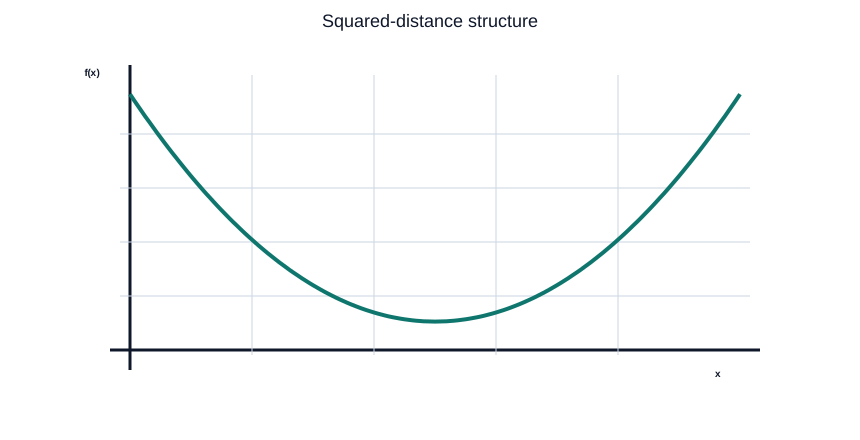
Unannotated coordinate graph of the parabola, without center or symmetry labels. Open full size
Your answer
Choose an answer
With a free account

Stop now. Continue later.

A saved learning session lets you leave when you need to and return without losing your place.

Create a free account
With paid access

Use the screen to choose. Use paper to solve.

Build the exact session you want online, then export it as a printable worksheet.

Compare plans

Hint

Rewrite the inside as variable−center.

(x−h) is signed displacement from h, |x−h| is distance, and (x−h)² gives equal values at h±d.

Solution walkthrough

01

Focus on the squared binomial

\[f(x)~=~(x-4)^2+7\]

The expression being interpreted is the squared part \((x-4)^2\).

02

Read the difference inside the parentheses

\[x-4\]

This shows how far the input \(x\) is from the value \(4\).

03

Square that distance

\[(x-4)^2\]

Squaring the difference turns the distance from \(x\) to \(4\) into a squared distance.

04

State the interpretation

\[\text{center}=4;~\text{signed}~\text{difference}=x−4;~\text{distance}=|x−4|;~\text{squared}-\text{distance}~\text{term}=(x−4)²;~\text{symmetry}~\text{consequence}=\text{inputs}4−d~\text{and}4+d~\text{give}~\text{equal}~\text{outputs}\]

That is the meaning of the squared binomial in this vertex-form expression.

+

Another way

  1. Think of points on a number line: \(x-4\) tells the horizontal distance from \(x\) to \(4\), and squaring keeps the focus on distance size.

!

Common mistake

Reading \((x-4)^2\) as meaning the distance is always \(4\) instead of recognizing that the distance depends on the current input \(x\).

Answer parabola labeling the center, symmetry axis, equal-output inputs, signed displacement, distance, and squared-distance term.
center=4; signed difference=x−4; distance=|x−4|; squared-distance term=(x−4)²; symmetry consequence=inputs4−d and4+d give equal outputs