All courses Math II · F-IF.7.b 22 of 73
Graph square-root, cube-root, absolute-value, step, and piecewise-defined functions, showing key features by hand in simple cases and with technology when the functions are more complicated.

Transform a fixed set of square-root parent points

Problem
For y=√x, evaluate the parent inputs u=0,1,4,9 and record each point (u,√u). Use the first point and the square-root restrictions to state the endpoint, domain, and range, then identify the point-and-feature set supported by your calculations.
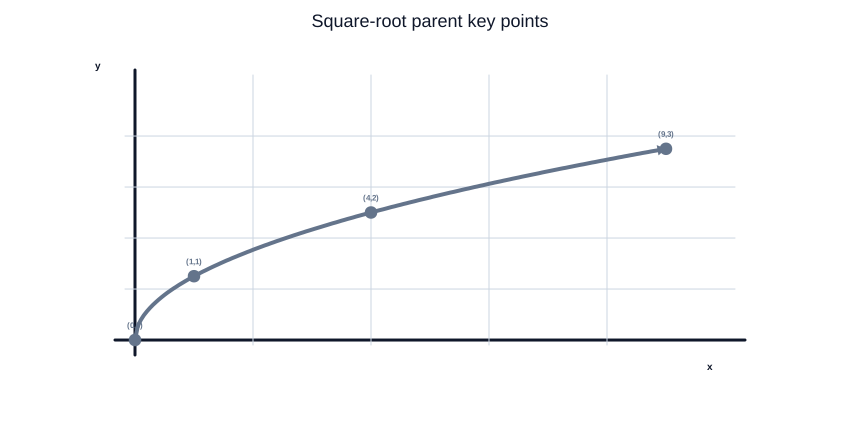
Source graph of the square-root parent points (0,0), (1,1), (4,2), and (9,3), corresponding to u=0,1,4,9. Open full size
Your answer
Choose an answer
With a free account

Let your results add up.

Each saved attempt adds useful evidence about what you have practiced and what deserves another pass.

Create a free account
With paid access

Use the screen to choose. Use paper to solve.

Build the exact session you want online, then export it as a printable worksheet.

Compare plans

Hint

Write the coordinate rule before calculating the four points.

Let u be the radicand. Transform (u,√u), not a random selection of x-values.

Solution walkthrough

01

Start with the square-root function

\[y~=~\sqrt{x}\]

We want easy input values that make the square root simple to evaluate.

02

Choose perfect-square x-values

\[x~=~0,1,4,9\]

These are convenient because their square roots are whole numbers.

03

Compute the corresponding y-values

\[\sqrt{0}~=~0,~\sqrt{1}~=~1,~\sqrt{4}~=~2,~\sqrt{9}~=~3\]

Each y-value is the square root of the chosen x-value.

04

List the key points

\[\text{rule}=(u,√u)→(u,√u);~u-\text{values}=0,1,4,9;~\text{points}=(0,0),(1,1),(4,2),(9,3);~\text{endpoint}=(0,0);~\text{domain}=[0,∞);~\text{range}=[0,∞);~\text{checks}=√0=0,√1=1,√4=2,√9=3\]

These are standard key points for graphing the parent square-root function.

+

Another way

  1. You can start with y-values \(0,1,2,3\) and square them to get the matching x-values \(0,1,4,9\).

!

Common mistake

Using consecutive x-values like \(0,1,2,3\), which does not give equally simple y-values for a square-root graph.

Answer graph of y=√x using u=0,1,4,9: points (0,0), (1,1), (4,2), and (9,3), endpoint (0,0), domain [0,∞), and range [0,∞).
rule=(u,√u)→(u,√u); u-values=0,1,4,9; points=(0,0),(1,1),(4,2),(9,3); endpoint=(0,0); domain=[0,∞); range=[0,∞); checks=√0=0,√1=1,√4=2,√9=3