All courses Math II · G-C.4 32 of 73
Construct a tangent line from an external point to a circle.

Identify the tangent points in the auxiliary-circle construction

Problem
An auxiliary circle with diameter OP intersects the original circle at A and B. Name the two points that serve as the tangency points for the tangent segments drawn from P.
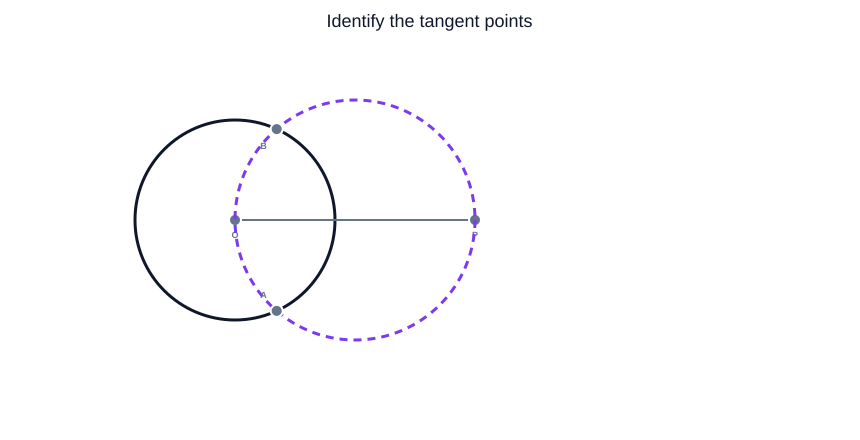
Unworked tangent diagram showing only the supplied configuration and givens. Open full size
Your answer
Show answer choicesAnswer choices Work through the mathematics first, then compare your reasoning.Select the answer that matches your work.
Answer choices
With a free account

Stop now. Continue later.

A saved learning session lets you leave when you need to and return without losing your place.

Create a free account
With paid access

Follow one course all the way through.

A one-course subscription opens every objective, problem type, and variant in the course you choose.

Compare plans

Hint

Look at point A first. Since A lies on the auxiliary circle whose diameter is OP, what kind of angle is ∠OAP?

Use the angle-in-a-semicircle idea: any angle that subtends diameter OP is 90°. Then use the tangent fact that a line perpendicular to a radius at the point on the circle is tangent there.

Solution walkthrough

01

Read the two-circle construction

\[\begin{aligned} OP~\text{is}~a~\text{diameter}~\text{of}~\text{the}~\text{auxiliary}~\text{circle} \\ A~\text{and}~B~\text{lie}~\text{on}~\text{both}~\text{circles} \end{aligned}\]

The original circle has center O. The auxiliary circle uses OP as a diameter and intersects the original circle at A and B, exactly as shown in the inspected source.

02

Create right angles from the diameter

\[\begin{aligned} \text{angle}~OAP=90~\text{degrees} \\ \text{angle}~OBP=90~\text{degrees} \end{aligned}\]

An angle inscribed in a semicircle is a right angle. Both angles subtend the auxiliary circle's diameter OP, so OA is perpendicular to PA and OB is perpendicular to PB.

03

Apply the radius-tangent criterion

\[\begin{aligned} OA~\text{is}~a~\text{radius}~\text{and}~OA~\text{perpendicular}~PA~->~PA~\text{tangent}~\text{at}~A \\ OB~\text{is}~a~\text{radius}~\text{and}~OB~\text{perpendicular}~PB~->~PB~\text{tangent}~\text{at}~B \end{aligned}\]

A line perpendicular to a radius at the radius endpoint is tangent to the original circle. Thus the segments from P touch the circle at the shared intersection points.

04

Name the requested points

\[\text{tangent}~\text{points}:~A~\text{and}~B\]

The construction produces two tangent segments, PA and PB, so their points of tangency are A and B.

+

Another way

  1. Use the right-angle marks in the completed construction directly with the radius-tangent converse theorem.

!

Common mistake

Do not name O or P as a tangent point. A tangent point must lie on the original circle and be the endpoint where a tangent is perpendicular to a radius; those points are A and B.

Completed tangent answer diagram with exact construction or verification.
tangent points: A and B