All courses Math II · G-GMD.3 38 of 73
Use volume formulas for cylinders, pyramids, cones, and spheres to solve problems.

Find the volume of a cylinder

Problem
A cylinder has radius 3 and height 10. Find its volume.
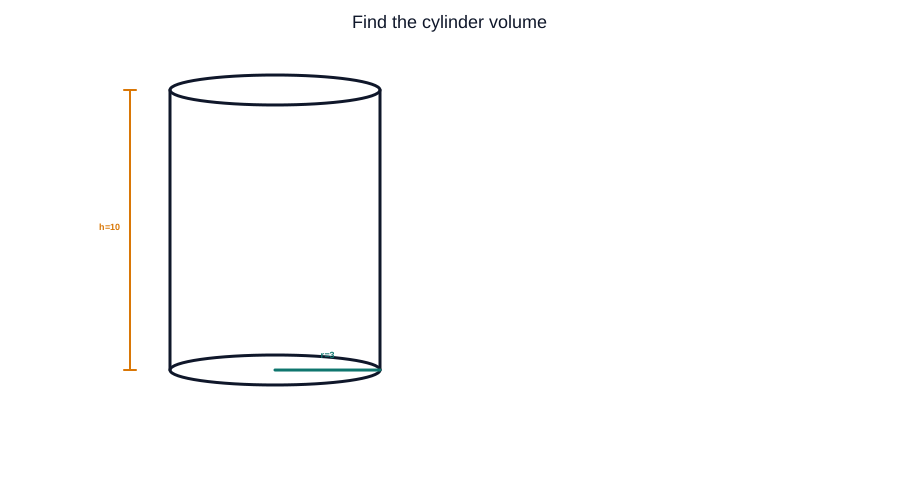
Unworked solid diagram showing only the supplied dimensions and unknowns. Open full size
Your answer
Show answer choicesAnswer choices Work through the mathematics first, then compare your reasoning.Select the answer that matches your work.
Answer choices
With a free account

Stop now. Continue later.

A saved learning session lets you leave when you need to and return without losing your place.

Create a free account
With paid access

Follow a skill back to its prerequisites.

All-course access lets you move between Math Foundations and Math I–III when an earlier idea needs attention.

Compare plans

Hint

Use the cylinder volume formula \(V=\pi r^2h\).

Square the radius first, then multiply by the height and by \(\pi\).

Solution walkthrough

01

Choose the cylinder relationship

\[V=\text{pi}~r^2~h\]

A cylinder has congruent circular cross-sections through its perpendicular height, so volume equals circular base area pi r squared times height h.

02

Source the two dimensions

\[r=3;~h=10\]

The prompt and inspected diagram label the base radius as 3 and the perpendicular height as 10. The radius, not the diameter, belongs in the formula.

03

Substitute after naming the formula

\[V=\text{pi}(3)^2(10)=\text{pi}(9)(10)\]

The radius is squared first, giving 9. The height factor remains 10.

04

Calculate and check dimensions

\[V=90\text{pi}~\text{cubic}~\text{units};~\text{units}^2~\text{times}~\text{units}=\text{units}^3\]

Multiplying 9 by 10 gives 90. Since base area has square units and height has linear units, the result correctly has cubic units.

+

Another way

  1. Find the base area first, pi(3 squared)=9pi square units, then multiply by height 10 to obtain 90pi cubic units.

!

Common mistake

Do not use V=pi r h. The radius must be squared because pi r squared is the area of the circular base.

Completed solid diagram with formula, substitution, and exact volume conclusion.
90π