All courses Math II · G-GPE.4 43 of 73
Use coordinates to prove simple geometric theorems, including simple circle theorems.

Compare two exact coordinate distances for congruence

Problem
Are segments AB and CD congruent? Use their coordinates to decide.
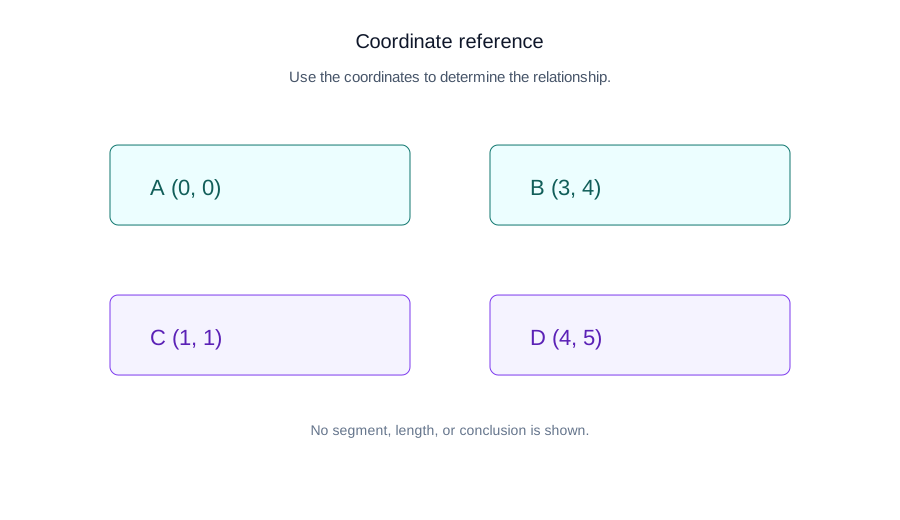
Neutral coordinate reference listing A (0, 0), B (3, 4), C (1, 1), and D (4, 5), without drawn segments or a length conclusion. Open full size
Your answer
Show answer choicesAnswer choices Work through the mathematics first, then compare your reasoning.Select the answer that matches your work.
Answer choices
With a free account

Explore all four courses.

Starter practice spans Math Foundations and Math I–III, so you can find the level and objective you need.

Create a free account
With paid access

Keep going when the starter set ends.

A subscription removes the locked gaps from your selected course so practice can continue through the full sequence.

Compare plans

Hint

Compute Δx and Δy for each segment in the same endpoint order.

Compare squared lengths first; equal nonnegative squared lengths imply equal lengths.

Solution walkthrough

01

Compute AB's displacement and squared length

\[AB~\text{vector}=<3-0,4-0\ge~<3,4>;~AB^2=3^2+4^2=25\]

The coordinate differences come from A(0,0) to B(3,4). Comparing squared lengths avoids unnecessary square roots at first.

02

Compute CD's displacement and squared length

\[CD~\text{vector}=<4-1,5-1\ge~<3,4>;~CD^2=3^2+4^2=25\]

From C(1,1) to D(4,5), the changes are again 3 horizontally and 4 vertically.

03

Convert and compare the lengths

\[AB=\text{sqrt}(25)=5;~CD=\text{sqrt}(25)=5\]

Segment lengths are nonnegative, so equal squared lengths imply the same positive length 5.

04

Apply the congruence definition

\[AB=CD=5~->~\text{segment}~AB~\text{congruent}~\text{to}~\text{segment}~CD\]

Congruent segments are exactly segments with equal lengths. Both independent distance calculations establish that condition.

+

Another way

  1. The displacement vectors are identical, <3,4>, so their magnitudes—and therefore the segment lengths—are identical.

!

Common mistake

Do not compare each endpoint's distance from the origin. Segment length uses coordinate differences between the two endpoints of that segment.

Answer proof: A(0,0) to B(3,4) has displacement ⟨3,4⟩, squared length 3²+4²=25, and length 5. C(1,1) to D(4,5) also has displacement ⟨3,4⟩, squared length 25, and length 5. Therefore AB≅CD.
Matching displacement triangles establish equal segment lengths.