All courses Math II · G-SRT.1.a 45 of 73
Verify that dilations send non-center-passing lines to parallel lines and leave center-passing lines unchanged.

Find a line image under dilation, including the invariant case

Problem
Find the exact image line under this dilation: center O=(0,0),k=2,line through P=(1,1),Q=(3,1).
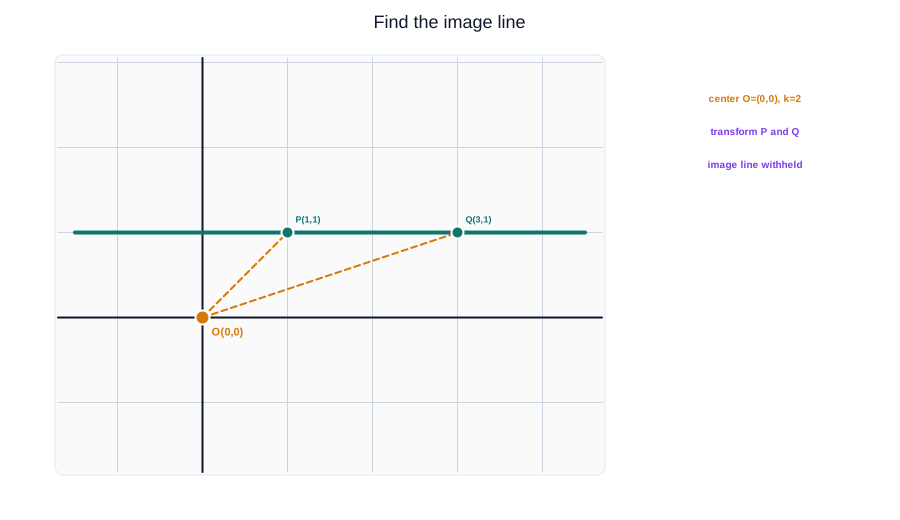
Unworked dilation setup with center O(0,0), k=2, and source points P(1,1) and Q(3,1) on y=1; P′, Q′, and the image-line equation are not shown. Open full size
Your answer
Show answer choicesAnswer choices Work through the mathematics first, then compare your reasoning.Select the answer that matches your work.
Answer choices
With a free account

See progress instead of guessing.

Gozunta keeps your results together so you can see what you have practiced and how it went.

Create a free account
With paid access

Give your progress record more evidence.

A larger problem bank gives you more chances to see whether a skill is becoming dependable.

Compare plans

Hint

Apply the coordinate rule to two distinct points on the line.

A dilation maps a center-passing line to itself; any other line maps to a parallel line.

Solution walkthrough

01

State the dilation rule

\[D_(O,2):(x,y)->(2x,2y)\]

A dilation centered at the origin multiplies both coordinates by the scale factor 2.

02

Map two distinct source points

\[P(1,1)->P'(2,2);~Q(3,1)->Q'(6,2)\]

The images of two different points determine the image line. Scaling both coordinates keeps each image on its ray from O.

03

Derive the image equation

\[P'_y=Q'_y=2~->~\text{image}~\text{line}~y=2\]

Both image points share y-coordinate 2 and have different x-coordinates, so their unique supporting line is horizontal at y=2.

04

Check the dilation theorem

\[\text{source}~y=1~\text{misses}~O;~\text{image}~y=2;~\text{slopes}~0~\text{and}~0;~\text{lines}~\text{distinct}\]

A line not through the dilation center maps to a distinct parallel line. The equations and equal slopes confirm that theorem here.

+

Another way

  1. Substitute y=y'/2 into source equation y=1, obtaining y'=2 directly.

!

Common mistake

Scale y as well as x. Mapping (1,1) to (2,1) is not a dilation by factor 2 from the origin.

Answer construction for center O(0,0) and k=2: P(1,1) maps to P′(2,2), and Q(3,1) maps to Q′(6,2). Thus source line y=1 maps to image line y=2, a distinct parallel line with the same direction.
Two transformed points determine the exact image line and its relation to the source.