All courses Math II · G-SRT.6 51 of 73
Define trigonometric ratios for acute angles using right-triangle similarity.

Assign separate opposite, adjacent-leg, and hypotenuse roles

Problem
In right triangle ABC, ∠C is the right angle and ∠A is the reference angle. Assign BC, AC, and AB to the opposite, adjacent, and hypotenuse roles relative to ∠A.
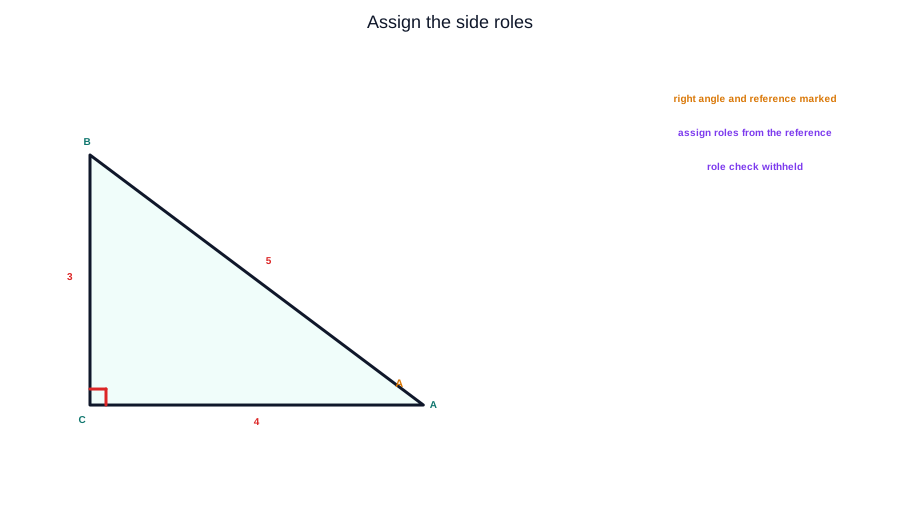
Prompt diagram of right triangle ABC with the right angle at C and reference angle A marked. The side lengths shown are BC = 3, AC = 4, and hypotenuse AB = 5; the opposite and adjacent role labels are withheld. Open full size
Your answer
Show answer choicesAnswer choices Work through the mathematics first, then compare your reasoning.Select the answer that matches your work.
Answer choices
With a free account

Find a specific skill faster.

Search the curriculum instead of wandering through random problems until the right kind appears.

Create a free account
With paid access

Learn from every walkthrough.

Unlock the complete problem bank and its worked solution walkthroughs, not only the walkthroughs in the starter set.

Compare plans

Hint

Locate the right angle and select its opposite side as hypotenuse.

The hypotenuse is opposite the right angle; of the two legs, the one touching the reference angle is adjacent and the other is opposite.

Solution walkthrough

01

Locate the hypotenuse first

\[\text{right}~\text{angle}~\text{at}~C~->~\text{side}~\text{opposite}~C~\text{is}~AB\]

The hypotenuse is always opposite the right angle, so AB has that role regardless of the reference angle.

02

Use reference angle A for the opposite side

\[\text{side}~\text{not}~\text{touching}~\text{angle}~A~\text{is}~BC\]

BC is across the triangle from angle A, so it is the opposite leg.

03

Identify the remaining touching leg

\[AC~\text{touches}~\text{angle}~A~\text{and}~\text{is}~\text{not}~\text{the}~\text{hypotenuse}~->~\text{adjacent}\]

The adjacent side in trigonometry is the nonhypotenuse side that forms the reference angle.

04

Check all roles and lengths

\[\text{opposite}=BC=3;~\text{adjacent}=AC=4;~\text{hypotenuse}=AB=5\]

The hypotenuse is longest and 3 squared plus 4 squared equals 5 squared, consistent with the diagram's right triangle.

+

Another way

  1. Cover the reference angle: the side across from it is opposite; of the two touching sides, remove the hypotenuse and the other is adjacent.

!

Common mistake

Both AB and AC touch angle A, but AB is the hypotenuse. The adjacent leg is therefore AC, not AB.

Answer diagram of right triangle ABC relative to angle A: BC, length 3, is opposite; AC, length 4, is adjacent; and AB, length 5, is the hypotenuse opposite right angle C.
The answer colors opposite, adjacent, and hypotenuse relative to the marked reference angle.