All courses Math III · A-REI.11 12 of 55
Solve f(x)=g(x) approximately using intersections of polynomial, rational, radical, absolute-value, exponential, and logarithmic graphs.

Estimate solutions by reading intersections of a polynomial graph and a line

Problem
Estimate the intersections of these polynomial and linear graphs from the graph data: the parabola and the line cross near (1,3) and (4,6).
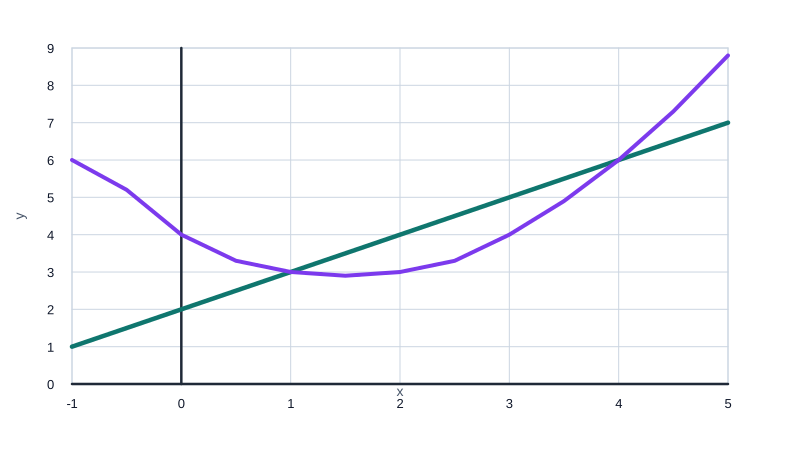
Coordinate graph showing a line and a parabola on the same grid for estimating two intersection points. Open full size
Your answer
Choose an answer
With a free account

Share practice with a session code.

Every learning session has a code, making it easy to share the same included practice with someone else.

Create a free account
With paid access

Separate understanding from one lucky answer.

Multiple variants of a problem type let you apply the method again before deciding that the skill is secure.

Compare plans

Hint

Read the x-values where the two graphs cross, then pair them with the nearby intersection coordinates.

An intersection estimate from a graph gives both the approximate x-solutions and the approximate crossing points when those coordinates are described.

Solution walkthrough

01

Identify the crossing points

\[(1,3)~\text{ and }(4,6)\]

The graph description says the parabola and the line cross near these two points.

02

Read the x-solutions

\[x~\approx~1~\text{ and }x~\approx~4\]

The x-values of the intersection points are the approximate solutions.

03

Keep the point estimates with them

\[(1,3),\ (4,6)\]

Since the question gives the crossing locations, include the approximate intersection coordinates too.

04

State the estimate clearly

\[\text{solutions }x~\approx~1,4\]

The graph suggests two intersections, near \((1,3)\) and \((4,6)\).

05

State the final answer

\[\text{The}~\text{estimated}~\text{solutions}~\text{are}~x≈1~\text{and}~x≈4,~\text{with}~\text{intersections}~\text{near}~(1,3)~\text{and}~(4,6).\]

The estimated solutions are \(x≈1\) and \(x≈4\), with intersections near \((1,3)\) and \((4,6)\).

+

Another way

  1. You can answer either by naming the full intersection points or by extracting just the x-values, since the x-coordinates are the solutions.

!

Common mistake

A common mistake is to report the y-values \(3\) and \(6\) as the solutions, even though the solution values come from the x-coordinates of the intersections.

Coordinate graph showing a line and a parabola with the intersection points open parenthesis 1 comma 3 close parenthesis and open parenthesis 4 comma 6 close parenthesis marked and labeled.