All courses Math III · F-TF.2 34 of 55
Use the unit circle to extend trig functions to all real-number radian measures.

Find cos(θ) and sin(θ) from a point on the unit circle

Problem
If a point on the unit circle is (1/2,sqrt(3)/2), what are cos(theta) and sin(theta)?
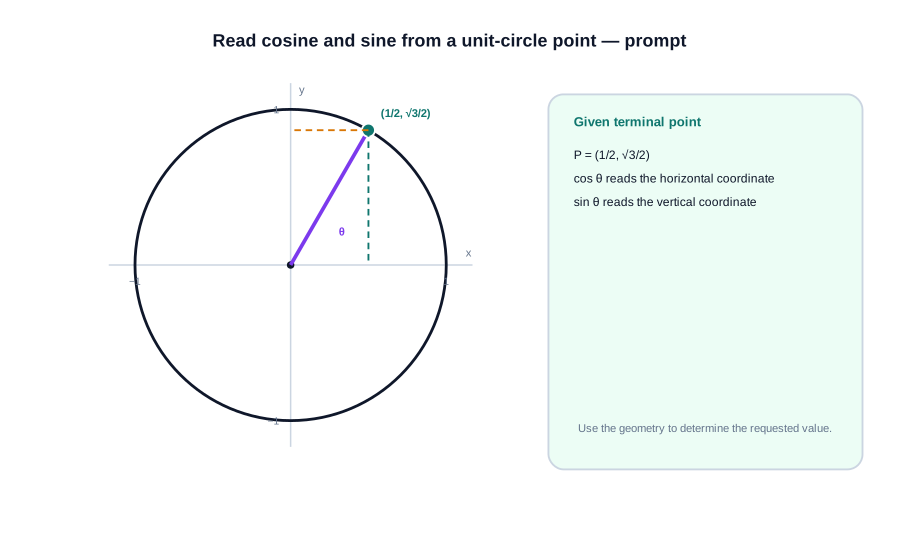
Prompt diagram for M3-034-A01-V01: a unit circle with the given terminal point and coordinate projections, without naming the requested trig values. Open full size
Your answer
Choose an answer
With a free account

Practice the problem type you meant to practice.

Navigate by objective and problem type instead of taking whichever free problem happens to come next.

Create a free account
With paid access

Give your progress record more evidence.

A larger problem bank gives you more chances to see whether a skill is becoming dependable.

Compare plans

Hint

On the unit circle, the x-coordinate is cos(theta) and the y-coordinate is sin(theta).

Match the first coordinate to cosine and the second coordinate to sine; do not swap the coordinate order.

Solution walkthrough

01

Use the unit-circle coordinates

\[\text{point}~=~(\cos(\text{theta}),~\sin(\text{theta}))\]

Every point on the unit circle has x-coordinate cos(theta) and y-coordinate sin(theta).

02

Read the given point

\[(1/2,\text{sqrt}(3)/2)~\text{has}~x~=~1/2~\text{and}~y~=~\text{sqrt}(3)/2\]

The given point has x-coordinate 1/2 and y-coordinate sqrt(3)/2.

03

Identify cosine

\[\cos(\text{theta})~=~1/2\]

The x-coordinate gives cosine, so cosine is 1/2.

04

Identify sine

\[\sin(\text{theta})~=~\text{sqrt}(3)/2\]

The y-coordinate gives sine, so sine is sqrt(3)/2.

05

State the values

\[\cos(\text{theta})~=~1/2~\text{and}~\sin(\text{theta})~=~\text{sqrt}(3)/2\]

The requested values are cosine first and sine second.

+

Another way

  1. The point is in Quadrant I, so both cosine and sine should be positive, which matches 1/2 and sqrt(3)/2.

!

Common mistake

Switching the coordinates and saying cos(theta) = sqrt(3)/2 and sin(theta) = 1/2. On the unit circle, cosine comes from x and sine comes from y.

Answer diagram for M3-034-A01-V01: the same geometry with cosine and sine identified as the x- and y-coordinates.