All courses Math III · G-GMD.4 37 of 55
Identify cross-sections of 3D objects and solids generated by rotating 2D objects.

Identify the cross-section formed when a prism is sliced parallel to its base

Problem
If a rectangular prism is cut parallel to its base, what cross-section is formed?
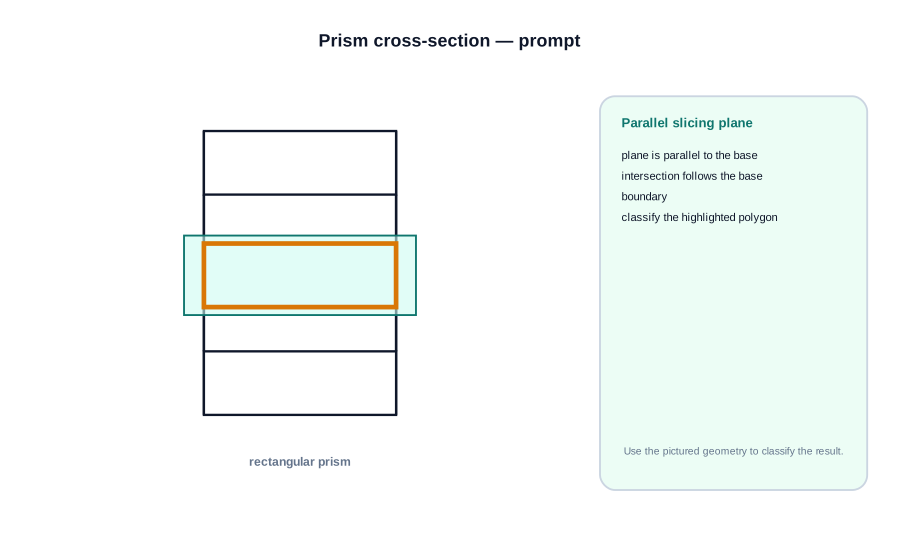
Prompt diagram for M3-037-A01-V01: a three-dimensional prism, oriented slicing plane, and highlighted intersection without its classification. Open full size
Your answer
Choose an answer
With a free account

Explore all four courses.

Starter practice spans Math Foundations and Math I–III, so you can find the level and objective you need.

Create a free account
With paid access

Learn from every walkthrough.

Unlock the complete problem bank and its worked solution walkthroughs, not only the walkthroughs in the starter set.

Compare plans

Hint

Identify the shape of the prism's base before naming the cross-section.

A plane parallel to a prism's base creates a cross-section congruent to that base.

Solution walkthrough

01

Identify the base shape

\[\text{base}~\text{shape}~=~\text{rectangle}\]

The solid is a rectangular prism, so its bases are rectangles. The base shape is the shape to track because the cut is parallel to the base.

02

Use the parallel-slice rule

\[\text{slice}~\text{parallel}~\text{to}~\text{base}~->~\text{same}~\text{shape}~\text{as}~\text{base}\]

A plane parallel to a prism's base keeps the same outline as that base throughout the prism.

03

Name the cross-section

\[\text{cross}-\text{section}~\text{shape}~=~\text{rectangle}\]

Since the base is a rectangle, the flat shape made by the slice is also a rectangle.

04

Relate it to the base

\[\text{cross}-\text{section}~\text{congruent}~\text{to}~\text{rectangular}~\text{base}\]

For a prism, this parallel cross-section is not just the same type of polygon; it is congruent to the base because it is a same-shape layer of the prism.

05

State the answer

\[\text{The}~\text{cross}-\text{section}~\text{is}~a~\text{rectangle}~\text{congruent}~\text{to}~\text{the}~\text{base}.\]

The requested cross-section is a 2D rectangle, and it can be described more completely as a rectangle congruent to the base.

+

Another way

  1. Think of the rectangular prism as a stack of congruent rectangles. A slice parallel to the stack's base picks out another rectangle.

!

Common mistake

A common mistake is to answer with the 3D solid, such as rectangular prism, instead of the flat 2D cross-section. The cut creates a rectangle, not another prism.

Answer diagram for M3-037-A01-V01: the same slice with the exact cross-section name and extracted polygon.