All courses Math Foundations · MF.PR.5 19 of 60
Determine whether a relationship is proportional from a table, graph, equation, or context.

Check proportionality from a table

Problem
The table shows the number of cups of rice and the total cost.

Cups of rice | Total cost ($)
1 | 2.50
2 | 5.00
4 | 10.00
6 | 15.00

Is this relationship proportional or not proportional?
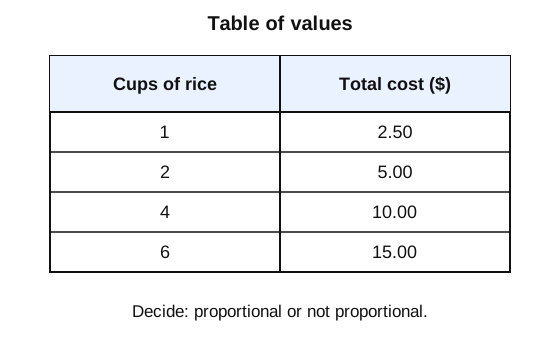
Two-column table labeled Cups of rice and Total cost in dollars. The rows are 1 and 2.50, 2 and 5.00, 4 and 10.00, and 6 and 15.00. Open full size
Your answer
Choose an answer
With a free account

Turn a few problems into a learning session.

Choose a course and objective, collect included problems into a session, and work through them in order.

Create a free account
With paid access

Follow a skill back to its prerequisites.

All-course access lets you move between Math Foundations and Math I–III when an earlier idea needs attention.

Compare plans

Hint

Start by finding the cost per cup in each row: divide total cost by cups of rice, using the same ratio each time.

A table is proportional only if every row has the same unit rate here, the same cost for 1 cup. Don’t focus on how much the cost increases from row to row.

Solution walkthrough

01

Use the same ratio for each row

\[\frac{2.50}{1},\ \frac{5.00}{2},\ \frac{10.00}{4},\ \frac{15.00}{6}\]

To decide whether a table is proportional, compare total cost to cups of rice in every row. A proportional table has the same cost per cup each time.

02

Find the cost per cup

\[\frac{2.50}{1}=2.50,\ \frac{5.00}{2}=2.50,\ \frac{10.00}{4}=2.50,\ \frac{15.00}{6}=2.50\]

Each row gives the same unit rate: $2.50 per cup. Since the multiplicative relationship stays constant, one rule works for the whole table.

03

State the constant relationship

\[\text{Total cost}=2.50\times(\text{cups of rice})\]

This shows the second quantity is always 2.50 times the first quantity, which is exactly what proportional means.

04

Make the proportionality judgment

\[\text{Proportional}\]

The relationship is proportional because every pair in the table has the same ratio of total cost to cups of rice.

+

Another way

  1. You can check by multiplication instead of division: 1 cup costs $2.50, so 2 cups should cost $5.00, 4 cups should cost $10.00, and 6 cups should cost $15.00. All of those match the table.

!

Common mistake

Looking only at the increases in cost. The cost goes up by $2.50, then $5.00, then $5.00, which is not a constant difference, but proportional relationships are about a constant ratio, not a constant difference.