All courses Math I · F-LE.1.a 28 of 59
Distinguish linear from exponential situations by equal differences versus equal factors over equal intervals.

Use first differences to identify a linear pattern

Problem
Use the displayed table. Compute first differences and classify the pattern using the requested evidence.
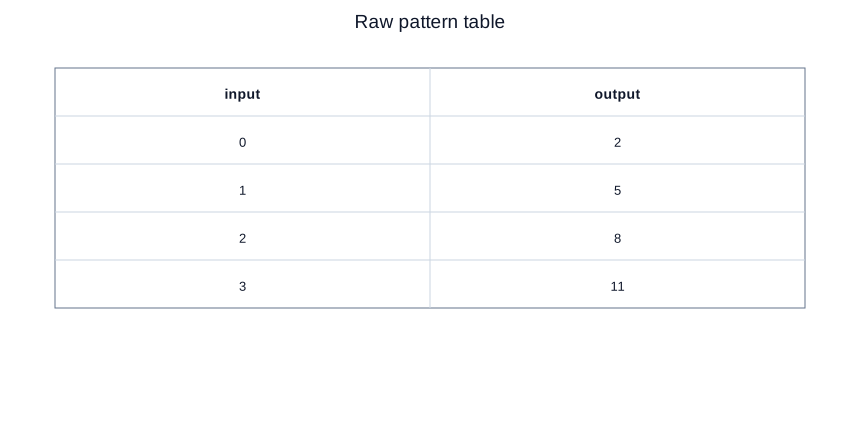
Raw input/output table without computed differences, ratios, or classification cues. Open full size
Your answer
Show answer choicesAnswer choices Work through the mathematics first, then compare your reasoning.Select the answer that matches your work.
Answer choices
With a free account

Take your practice with you.

Sign in on the web or in the iPhone and iPad app to use the same saved sessions and results.

Create a free account
With paid access

Learn from every walkthrough.

Unlock the complete problem bank and its worked solution walkthroughs, not only the walkthroughs in the starter set.

Compare plans

Hint

Subtract consecutive outputs to find the first differences: \(5-2\), \(8-5\), and \(11-8\).

A pattern is linear when the first differences are constant over equal input intervals.

Solution walkthrough

01

Find the first difference between the first two outputs

\[5-2~=~3\]

The first difference measures how much the output changes from one row to the next.

02

Find the remaining first differences

\[\begin{aligned} 8-5~=~3 \\ 11-8~=~3 \end{aligned}\]

Keep subtracting consecutive outputs. Each change is 3.

03

List the first differences

\[\text{differences}:~3,~3,~3\]

The first differences are all the same, so the pattern changes by a constant amount each step.

04

Classify the pattern

\[\text{classification}:~\text{linear};~\text{differences}:~3,~3,~3\]

Because the first differences are constant over equal input intervals, the table represents a linear pattern.

+

Another way

  1. You can notice that the outputs go up by 3 each time: \(2 -> 5 -> 8 -> 11\). A constant increase means the pattern is linear.

!

Common mistake

A common mistake is to subtract in the wrong order and write \(-3, -3, -3\). Since the outputs are increasing, each next value minus the previous value is \(+3\).

First-differences pattern card showing outputs 2, 5, 8, 11 with cues to subtract consecutive outputs and check whether the differences match.
classification: linear; differences: 3, 3, 3