All courses Math I · F-LE.1.b 29 of 59
Recognize constant rate of change as evidence for a linear model.

Find constant rate of change from a table

Problem
Use the displayed x-y table. Compute the signed interval rate or rates and answer the constant-rate question.
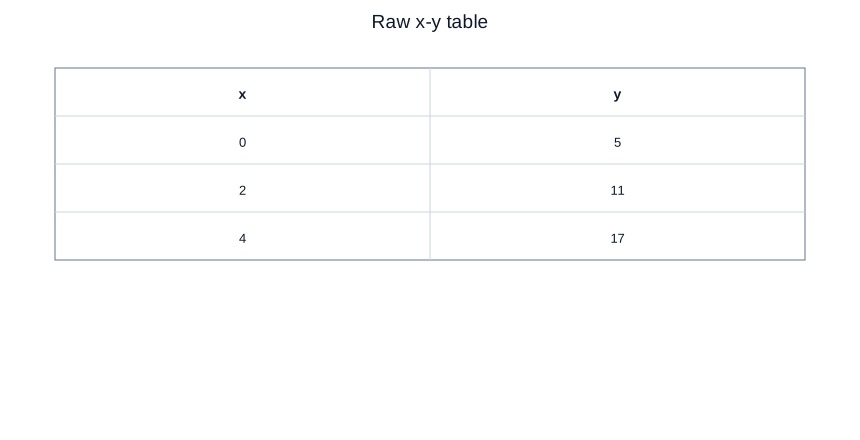
Clean source table or point graph without solution cues. Open full size
Your answer
Show answer choicesAnswer choices Work through the mathematics first, then compare your reasoning.Select the answer that matches your work.
Answer choices
With a free account

Let your results add up.

Each saved attempt adds useful evidence about what you have practiced and what deserves another pass.

Create a free account
With paid access

Use the screen to choose. Use paper to solve.

Build the exact session you want online, then export it as a printable worksheet.

Compare plans

Hint

Use two consecutive points, such as (0, 5) and (2, 11), and compute change in output over change in input: (11 - 5)/(2 - 0).

Constant rate of change means change in output divided by change in input. Divide the output change by the input change, and keep the units as output units per input unit.

Solution walkthrough

01

Choose two points from the table

\[(0,~5)~\text{and}~(2,~11)\]

Any pair of points from a constant-rate table will give the same rate, so start with the first two listed points.

02

Compute the changes

\[\begin{aligned} 11~-~5~=~6 \\ 2~-~0~=~2 \end{aligned}\]

The output increases by 6 while the input increases by 2.

03

Find the rate of change

\[6/2~=~3\]

Rate of change is change in output divided by change in input, so divide 6 by 2.

04

State the rate with units

\[3~\text{output}~\text{units}~\text{per}~\text{input}~\text{unit}\]

The table changes by 3 output units for every 1 input unit, so the constant rate of change is 3 output units per input unit.

+

Another way

  1. You can also use the next pair (2, 11) and (4, 17): the output again changes by 6 while the input changes by 2, so the rate is still 3.

!

Common mistake

A common mistake is to report the output change 6 instead of the rate 3. You must divide the change in output by the change in input.

Worked answer representation with the requested signed rate, completion, or diagnosis.
3 output units per input unit