All courses Math I · F-LE.2 31 of 59
Construct linear and exponential functions, including arithmetic/geometric sequences, from graphs, descriptions, or input-output pairs.

Construct a linear function from graph points

Problem
Use the displayed plotted points to construct the linear function.
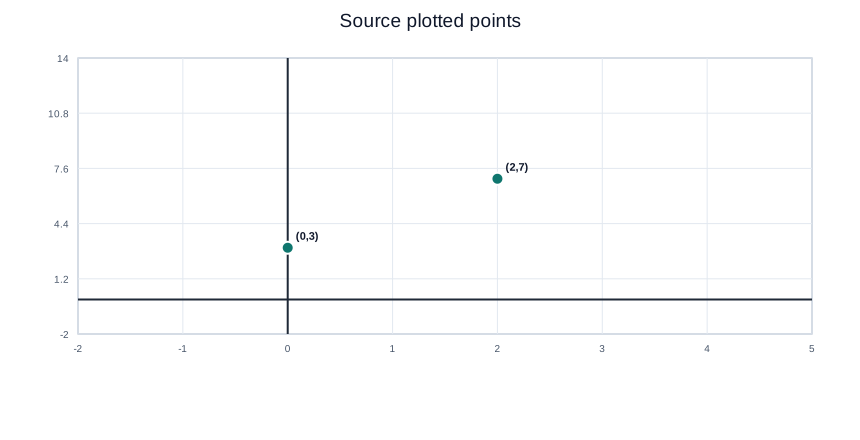
Coordinate graph with plotted points (0, 3) and (2, 7). Open full size
Your answer
Show answer choicesAnswer choices Work through the mathematics first, then compare your reasoning.Select the answer that matches your work.
Answer choices
With a free account

Practice the problem type you meant to practice.

Navigate by objective and problem type instead of taking whichever free problem happens to come next.

Create a free account
With paid access

Learn from every walkthrough.

Unlock the complete problem bank and its worked solution walkthroughs, not only the walkthroughs in the starter set.

Compare plans

Hint

Use the two points \((0, 3)\) and \((2, 7)\) to find the slope: rise over run.

Once you know the slope, use the point with \(x = 0\) to read the y-intercept directly. Then write the equation in the form \(f(x)=mx+b\).

Solution walkthrough

01

Read the plotted points and bounds

\[(0,3)~\text{and}~(2,7)\]

The inspected coordinate graph labels exactly these points; both lie inside its displayed x- and y-bounds.

02

Compute the slope

\[m=(7-3)/(2-0)=4/2=2\]

Output rises 4 while input runs 2, so the signed constant rate is positive 2.

03

Identify the intercept and build the rule

\[(0,3)~->~b=3;~f(x)=\text{mx}+b=2x+3\]

The point with x=0 directly supplies the y-intercept 3. Combining it with slope 2 gives the linear function.

04

State and check the function

\[f(x)=2x+3\]

Substitution gives f(2)=2(2)+3=7, reproducing the second plotted point and checking the model.

+

Another way

  1. Starting at y=3 when x=0, the graph rises 2 per input unit, giving values 3,5,7 and the same rule.

!

Common mistake

Do not use the y-change 4 as slope. Slope is rise divided by run, so 4/2=2.

Worked linear model: slope (7-3)/(2-0)=2 and intercept 3, so f(x)=2x+3.
model: f(x)=2x+3