All courses Math I · F-LE.3 32 of 59
Use graphs/tables to see that exponential growth eventually exceeds linear, quadratic, and polynomial growth.

Compare linear and exponential values over the same inputs

Problem
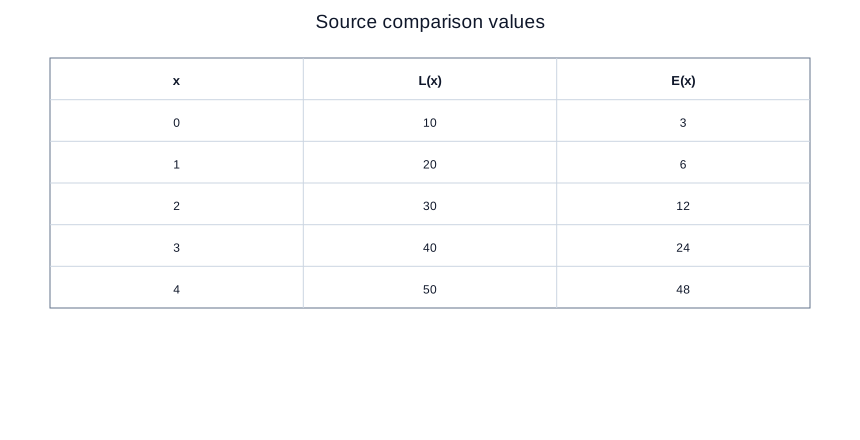
Use the displayed table to determine the linear and exponential models, compare their values and gaps at every listed input, calculate both values at x = 5, and locate the crossing bracket and first listed integer where the exponential model overtakes the linear model.
Comparison table with rows x=0: L=10, E=3; x=1: L=20, E=6; x=2: L=30, E=12; x=3: L=40, E=24; x=4: L=50, E=48. Open full size
Your answer
Show answer choicesAnswer choices Work through the mathematics first, then compare your reasoning.Select the answer that matches your work.
Answer choices
With a free account

Practice the problem type you meant to practice.

Navigate by objective and problem type instead of taking whichever free problem happens to come next.

Create a free account
With paid access

Separate understanding from one lucky answer.

Multiple variants of a problem type let you apply the method again before deciding that the skill is secure.

Compare plans

Hint

Compare the two patterns term by term at the same input values instead of looking only at how they change.

A linear pattern grows by equal differences, while an exponential pattern grows by equal factors. Exponential growth can start smaller and still catch up later.

Solution walkthrough

01

Derive both models from the inspected table

\[L:~\text{start}~10,~\text{difference}~10~->~L(x)=10+10x;~E:~\text{start}~3,~\text{ratio}~2~->~E(x)=3·2ˣ\]

The linear column adds 10 per unit input, while the exponential column doubles from initial value 3.

02

Compare every listed row and gap

\[x=0..4:~L-E=7,14,18,16,2;~\text{therefore}~L>E~\text{at}~\text{each}~\text{listed}~\text{input}\]

Direct subtraction accounts for all five source rows and shows the exponential column nearly catches the linear column by x=4.

03

Calculate the next values and bracket the overtake

\[L(5)=10+10(5)=60;~E(5)=3·2⁵=96\]

At x=4, L=50 exceeds E=48; at x=5, E=96 exceeds L=60. Thus the switch occurs between 4 and 5, and 5 is the first listed integer where E is greater.

04

State the complete comparison

\[\text{models}~=~L(x)=10+10x~\text{and}~E(x)=3·2ˣ;~\text{comparisons}~=~L>E~\text{at}~x=0,1,2,3,4;~\text{gaps}~L-E~=~7,14,18,16,2;~\text{next}~\text{values}~=~L(5)=60,~E(5)=96;~\text{overtake}~=~E~\text{first}~\text{exceeds}~L~\text{at}~\text{listed}~\text{integer}~x=5,~\text{between}~x=4~\text{and}~x=5\]

The result includes the two rules, every displayed comparison, all gaps, the next evaluations, and the exact consecutive-input bracket requested.

+

Another way

  1. Compare D(x)=L(x)-E(x); D(4)=2>0 and D(5)=-36<0 bracket the first listed-integer reversal.

!

Common mistake

Do not infer an overtake merely because the gap shrinks. Calculate both models at x=5 to verify that their order actually reverses.

Worked comparison: L(x)=10+10x exceeds E(x)=3·2ˣ through x=4; L(5)=60 and E(5)=96, so the first listed integer overtake is x=5 and the crossing is between 4 and 5.
models = L(x)=10+10x and E(x)=3·2ˣ; comparisons = L>E at x=0,1,2,3,4; gaps L-E = 7,14,18,16,2; next values = L(5)=60, E(5)=96; overtake = E first exceeds L at listed integer x=5, between x=4 and x=5