All courses Math I · G-CO.12 35 of 59
Perform formal constructions with compass/straightedge, paper folding, string, reflective devices, or geometry software.

Find a midpoint using construction reasoning

Problem
Use the displayed perpendicular-bisector construction to identify the midpoint of AB and justify it from the point's incidence and equal distances to A and B.
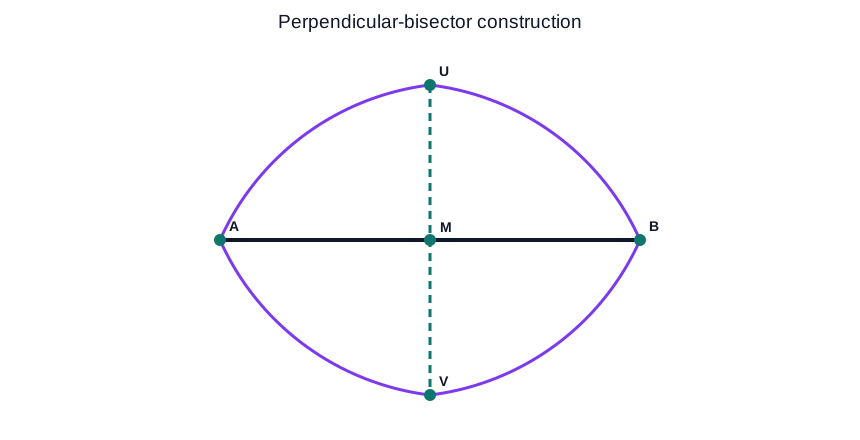
Construction arcs intersect at U and V; line UV intersects segment AB at labeled point M. Open full size
Your answer
Show answer choicesAnswer choices Work through the mathematics first, then compare your reasoning.Select the answer that matches your work.
Answer choices
With a free account

Take your practice with you.

Sign in on the web or in the iPhone and iPad app to use the same saved sessions and results.

Create a free account
With paid access

Give your progress record more evidence.

A larger problem bank gives you more chances to see whether a skill is becoming dependable.

Compare plans

Hint

Use point \(M\), where the perpendicular bisector meets segment \(AB\).

The perpendicular bisector of a segment crosses the segment at its midpoint, because every point on the perpendicular bisector is equidistant from the two endpoints.

Solution walkthrough

01

Inspect the construction incidence

\[M~\text{lies}~\text{on}~\text{segment}~AB~\text{and}~\text{on}~\text{line}~UV\]

The actual diagram places M at the intersection of horizontal segment AB and the constructed vertical line through arc intersections U and V.

02

Use equal-radius construction evidence

\[UA=UB~\text{and}~VA=VB\]

The paired arcs are drawn with equal radii from A and B, so both arc-intersection points are equidistant from the segment endpoints. Line UV is therefore the perpendicular bisector of AB.

03

Apply the perpendicular-bisector property

\[UV~\text{meets}~AB~\text{at}~M~->~MA=MB\]

A perpendicular bisector crosses its segment at the point equidistant from both endpoints, so M divides AB into equal lengths.

04

State the midpoint and justification

\[\text{Point}~M~\text{is}~\text{the}~\text{midpoint}~\text{of}~AB~\text{because}~\text{it}~\text{is}~\text{where}~\text{the}~\text{perpendicular}~\text{bisector}~\text{meets}~AB,~\text{so}~MA~=~MB.\]

The conclusion names M, its incidence on AB, and the equality that proves midpoint status.

+

Another way

  1. Use symmetry of the equal-radius arcs about their common chord UV to show it bisects AB at M.

!

Common mistake

Do not call U or V the midpoint. They are arc intersections off segment AB; the midpoint must lie on AB at M.

Completed construction: equal-radius arcs from A and B meet at U and V; line UV crosses segment AB at M; because M lies on the perpendicular bisector, MA=MB, so M is the midpoint of AB.
midpoint: M; reason: M is where the perpendicular bisector meets AB, so M is equidistant from A and B