All courses Math I · G-CO.13 36 of 59
Construct an equilateral triangle, square, and regular hexagon inscribed in a circle.

Identify a regular polygon construction from its steps

Problem
Use the displayed construction state. Identify the regular polygon produced by the shown equal-step, diameter, or equal-radius construction.
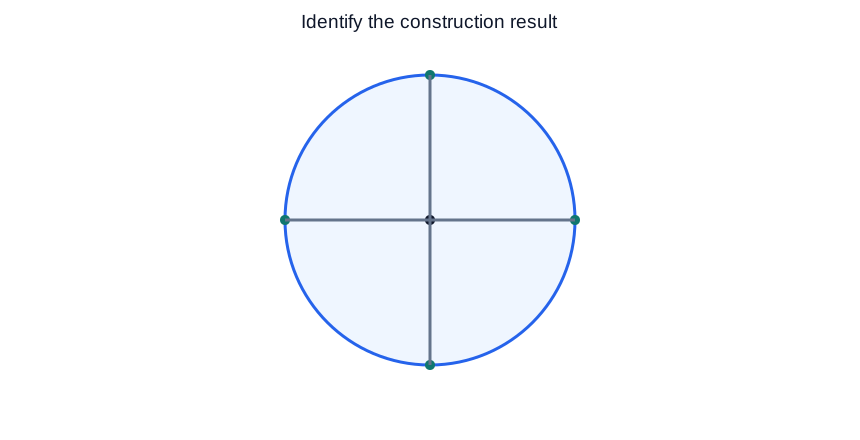
Clean source or partial regular-polygon construction without the requested conclusion. Open full size
Your answer
Show answer choicesAnswer choices Work through the mathematics first, then compare your reasoning.Select the answer that matches your work.
Answer choices
With a free account

See progress instead of guessing.

Gozunta keeps your results together so you can see what you have practiced and how it went.

Create a free account
With paid access

Take the session to paper.

Export learning sessions as spacious printable PDFs when pencil-and-paper practice works better.

Compare plans

Hint

Count how many vertices the construction creates when you use the four endpoints of the two diameters.

Two perpendicular diameters create four equally spaced points on the circle. A regular polygon with four equal vertices on the circle is an inscribed square.

Solution walkthrough

01

Read the construction marks

\[\text{two}~\text{perpendicular}~\text{diameters}\]

The inspected prompt diagram shows one horizontal and one vertical diameter crossing at the circle's center.

02

Count the candidate vertices

\[2~\text{endpoints}~\text{per}~\text{diameter};~2~\text{diameters}~\text{give}~4~\text{circle}~\text{points}\]

Each diameter ends at two points on the circle, so the construction supplies four distinct vertices.

03

Use the right-angle spacing

\[360/4~=~90~\text{degrees}~\text{between}~\text{adjacent}~\text{points}\]

Perpendicular diameters divide the circle into four equal quarter-turns. Connecting adjacent endpoints makes four equal chords and four right angles.

04

Name the constructed polygon

\[\text{inscribed}~\text{square}\]

A regular four-sided polygon whose vertices lie on the circle is an inscribed square.

+

Another way

  1. Recognize that joining the endpoints of perpendicular diameters always forms an inscribed square.

!

Common mistake

Do not answer rectangle merely because opposite sides would be parallel. The perpendicular diameters create equal quarter-arcs, so all four side chords are equal.

Annotated answer diagram marking the completed regular polygon, central angle, invariant, or comparison.
polygon: inscribed square