All courses Math I · G-CO.3 38 of 59
Describe rotations and reflections that carry rectangles, parallelograms, trapezoids, or regular polygons onto themselves.

Identify reflection symmetry lines for a rectangle or square

Problem
Identify the lines of reflection symmetry for a non-square rectangle centered at the origin with horizontal and vertical sides.
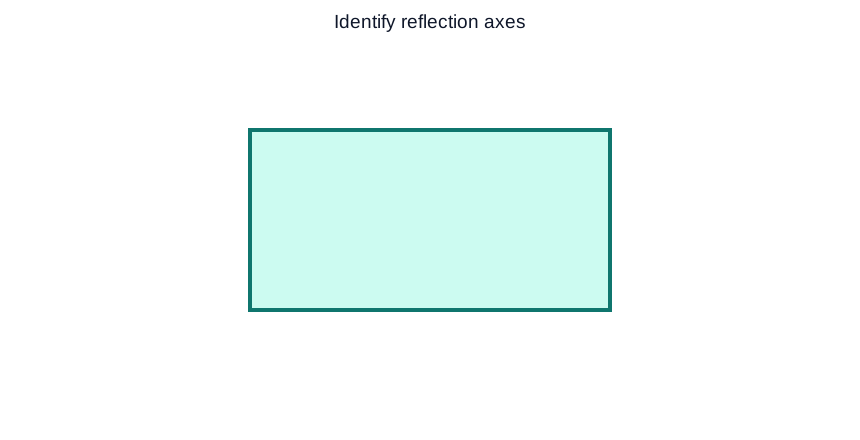
Clean source shape or proposed symmetry without the requested conclusion. Open full size
Your answer
Show answer choicesAnswer choices Work through the mathematics first, then compare your reasoning.Select the answer that matches your work.
Answer choices
With a free account

Let your results add up.

Each saved attempt adds useful evidence about what you have practiced and what deserves another pass.

Create a free account
With paid access

Give your progress record more evidence.

A larger problem bank gives you more chances to see whether a skill is becoming dependable.

Compare plans

Hint

Look for reflection lines that split the rectangle into matching left-right or top-bottom halves.

For a non-square rectangle with horizontal and vertical sides centered at the origin, the symmetry lines are the horizontal and vertical lines through the center.

Solution walkthrough

01

Use the stated center and orientation

\[\text{center}~=~(0,0);~\text{sides}~\text{are}~\text{horizontal}~\text{and}~\text{vertical}\]

The rectangle is centered at the origin, so any reflection axis that swaps equal halves must pass through (0,0). The inspected diagram confirms the horizontal orientation and unequal length and width.

02

Test the vertical centerline

\[x~=~0\]

Reflection across the y-axis swaps the rectangle's left and right halves while preserving the top and bottom edges.

03

Test the horizontal centerline

\[y~=~0\]

Reflection across the x-axis swaps the top and bottom halves while preserving the left and right edges. Diagonals are not axes because the rectangle is not a square.

04

List all reflection axes

\[x~=~0~\text{and}~y~=~0\]

The vertical and horizontal lines through the origin are the two and only two reflection-symmetry lines.

+

Another way

  1. Imagine folding the rectangle through its vertical center and then through its horizontal center; each fold matches corresponding vertices.

!

Common mistake

Do not include x=y or y=-x. Diagonal reflection would interchange the unequal length and width, so a non-square rectangle would not land on itself.

Shape annotated with all requested reflection axes, rotations, or validity conclusion.
symmetry lines: x=0, y=0