All courses Math I · G-CO.4 39 of 59
Define rotations, reflections, and translations using geometric language: angles, circles, perpendicular/parallel lines, and segments.

Define a translation using geometric language

Problem
Describe the translation represented by the vector right 5, up 2.
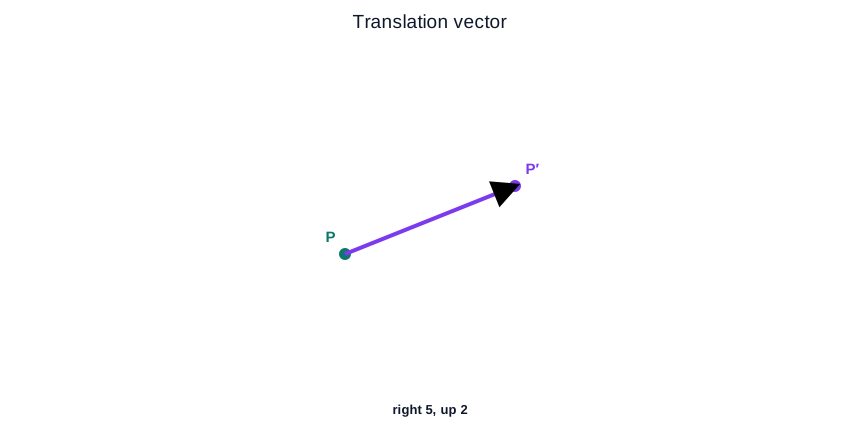
Geometric source diagram presenting the points, line, center, or vector named in the problem. Open full size
Your answer
Show answer choicesAnswer choices Work through the mathematics first, then compare your reasoning.Select the answer that matches your work.
Answer choices
With a free account

Share practice with a session code.

Every learning session has a code, making it easy to share the same included practice with someone else.

Create a free account
With paid access

Connect the whole math pathway.

All-course access opens Math Foundations and Math I–III, from prerequisite review through advanced work.

Compare plans

Hint

Read the horizontal and vertical parts of the vector separately: right \(5\), then up \(2\).

A translation moves every point of a figure the same distance and direction, so all image points are connected by parallel directed segments.

Solution walkthrough

01

Read the horizontal component

\[\text{horizontal}~\text{displacement}~=~5~\text{units}~\text{right}\]

The vector's first stated component gives a positive five-unit horizontal movement.

02

Read the vertical component

\[\text{vertical}~\text{displacement}~=~2~\text{units}~\text{up}\]

The second stated component gives a positive two-unit vertical movement.

03

Apply one common vector

\[\text{every}~\text{point}~\text{receives}~\text{displacement}~(5,2)\]

A translation applies the same directed displacement to every point, as the inspected P-to-P-prime arrow illustrates.

04

Describe the translation

\[\text{Every}~\text{point}~\text{moves}~5~\text{units}~\text{right}~\text{and}~2~\text{units}~\text{up}.\]

This sentence includes both vector components and correctly applies them to every point.

+

Another way

  1. State that every point follows a parallel directed segment with component displacement (5,2).

!

Common mistake

Do not swap the two components. The first describes horizontal movement and the second describes vertical movement.

Annotated geometric diagram showing the defining transformation conditions and result.
definition: every point moves 5 units right and 2 units up along parallel directed segments