All courses Math I · G-CO.6 41 of 59
Use rigid motions to transform figures and decide whether two figures are congruent.

Decide congruence by verifying a translation

Problem
Are these figures congruent by a translation? Compare preimage vertices 0, 0; 3, 0; 0, 2 with image vertices 5, -1; 8, -1; 5, 1.
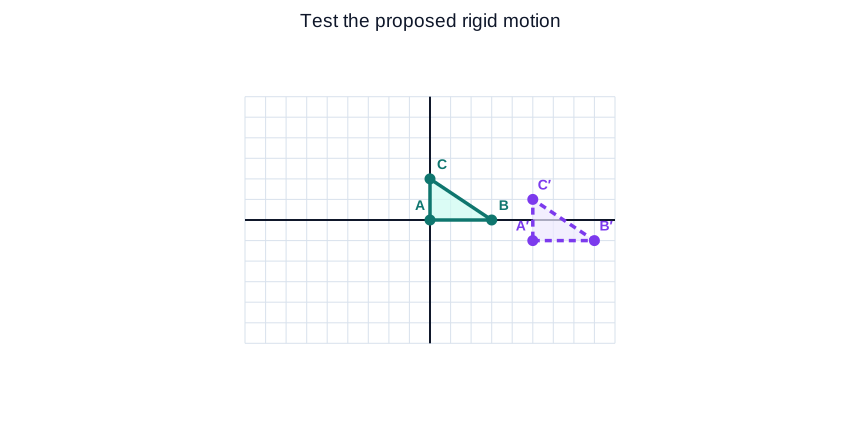
Source and image triangles: (0,0),(3,0),(0,2) correspond to (5,-1),(8,-1),(5,1). Open full size
Your answer
Show answer choicesAnswer choices Work through the mathematics first, then compare your reasoning.Select the answer that matches your work.
Answer choices
With a free account

Take your practice with you.

Sign in on the web or in the iPhone and iPad app to use the same saved sessions and results.

Create a free account
With paid access

Learn from every walkthrough.

Unlock the complete problem bank and its worked solution walkthroughs, not only the walkthroughs in the starter set.

Compare plans

Hint

Compare one preimage vertex to its image to find the translation vector, then test whether the same vector works for the other vertices.

Figures are congruent by a translation only if every corresponding vertex moves by one common vector.

Solution walkthrough

01

Compute a candidate translation

\[(0,0)~\text{to}~(5,-1)~\text{gives}~\text{vector}~(5,-1)\]

The first corresponding pair moves five units right and one unit down.

02

Verify the remaining pairs

\[(3,0)+(5,-1)=(8,-1);~(0,2)+(5,-1)=(5,1)\]

The same vector maps both remaining preimage vertices to the listed image vertices.

03

Use the rigid-motion consequence

\[\text{one}~\text{translation}~\text{maps}~\text{the}~\text{entire}~\text{triangle};~\text{distances}~\text{and}~\text{angles}~\text{are}~\text{preserved}\]

A translation is a rigid motion, so an exact vertex match proves the figures have equal size and shape.

04

State the congruence conclusion

\[\text{Yes},~\text{the}~\text{figures}~\text{are}~\text{congruent}~\text{because}~\text{each}~\text{vertex}~\text{moves}~\text{by}~\text{the}~\text{same}~\text{translation}~\text{vector}~⟨5,-1⟩.\]

All three checked correspondences use the single vector required for congruence by translation.

+

Another way

  1. Observe that adding (5,-1) to the entire inspected preimage triangle makes it coincide with the image triangle.

!

Common mistake

Do not use a vector between two vertices of the same triangle. Compare each preimage vertex with its designated image vertex.

Worked result: Every corresponding vertex moves by ⟨5,-1⟩, so one translation maps the first triangle onto the second and they are congruent.
congruent: yes; translation: <5,-1>