All courses Math I · G-CO.7 42 of 59
Use rigid motions to show triangle congruence through corresponding sides and angles.

Identify corresponding sides and angles from congruence notation

Problem
In the congruence statement triangle ABC congruent to triangle DEF, identify the corresponding sides and angles.
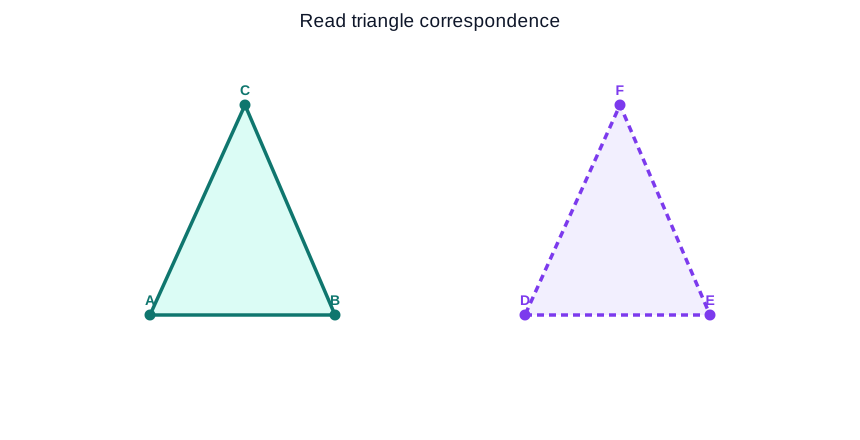
Triangle or coordinate diagram presenting only the geometric data supplied in the prompt. Open full size
Your answer
Show answer choicesAnswer choices Work through the mathematics first, then compare your reasoning.Select the answer that matches your work.
Answer choices
With a free account

Practice the problem type you meant to practice.

Navigate by objective and problem type instead of taking whichever free problem happens to come next.

Create a free account
With paid access

Try the same skill with new numbers.

More variants let you check whether you understand the method instead of remembering one answer.

Compare plans

Hint

Read the congruence statement in order so the first letters match, the second letters match, and the third letters match.

In a congruence statement, corresponding vertices are listed in matching positions.

Solution walkthrough

01

Read corresponding vertices

\[A~\text{corresponds}~\text{to}~D;~B~\text{corresponds}~\text{to}~E;~C~\text{corresponds}~\text{to}~F\]

The inspected congruence diagram places A, B, C in the same relative positions as D, E, F.

02

Form the angle pairs

\[A=D;~B=E;~C=F\]

Corresponding vertices determine the corresponding angles.

03

Form the side pairs

\[AB=DE;~BC=EF;~AC=DF\]

A side corresponds to the side joining the partners of its two endpoints.

04

Report every correspondence

\[\text{angles}:~A=D,~B=E,~C=F;~\text{sides}:~AB=DE,~BC=EF,~AC=DF\]

The answer lists all three corresponding angles and all three corresponding sides in the requested categories.

+

Another way

  1. Write A B C above D E F, then build each angle and side pair column by column.

!

Common mistake

Do not pair sides by how they look alone. Map both endpoints first; for example, B-C becomes E-F.

Annotated triangle diagram showing correspondence, congruence evidence, invariant, and conclusion.
corresponding angles: angle A=angle D, angle B=angle E, angle C=angle F; corresponding sides: AB=DE, BC=EF, AC=DF