All courses Math I · S-ID.5 53 of 59
Summarize two-category data with two-way tables and interpret joint, marginal, and conditional relative frequencies.

Complete a two-way frequency table from raw counts

Problem
Use these raw counts to complete the two-way frequency table: 30 students: 8 prefer cats and own pets, 7 prefer cats and do not own pets, 10 prefer dogs and own pets, 5 prefer dogs and do not own pets.
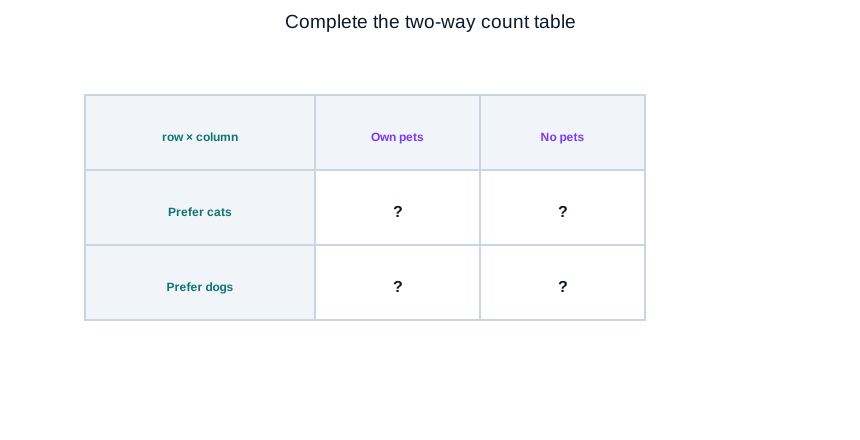
A genuine two-way matrix containing only the given information, with requested cells or totals left unresolved. Open full size
Your answer
Show answer choicesAnswer choices Work through the mathematics first, then compare your reasoning.Select the answer that matches your work.
Answer choices
With a free account

Turn browsing into a plan.

Pick an objective, make a session, and give your practice a clear beginning and end.

Create a free account
With paid access

Revisit a weak spot without repeating one problem.

Use additional variants to practice the same idea again while still having to do the mathematics.

Compare plans

Hint

Use pet preference for one direction and pet ownership for the other, then match each raw count to the cell named by both labels.

A two-way table cell records one combined category, such as cats and own pets or dogs and do not own pets.

Solution walkthrough

01

Read the table categories

\[\text{rows}=\text{prefer}~\text{cats},~\text{prefer}~\text{dogs};~\text{columns}=\text{own}~\text{pets},~\text{no}~\text{pets}\]

Each interior cell must combine exactly one preference row with exactly one pet-ownership column.

02

Place the cat-preference counts

\[\text{prefer}~\text{cats}~\text{and}~\text{own}~\text{pets}=8;~\text{prefer}~\text{cats}~\text{and}~\text{no}~\text{pets}=7\]

The prompt gives 8 students in the cats-and-own-pets combination and 7 in the cats-and-no-pets combination.

03

Place the dog-preference counts

\[\text{prefer}~\text{dogs}~\text{and}~\text{own}~\text{pets}=10;~\text{prefer}~\text{dogs}~\text{and}~\text{no}~\text{pets}=5\]

The remaining two stated groups belong in the dog-preference row under their matching ownership columns.

04

Check the survey total

\[8+7+10+5=30\]

The four disjoint table cells add to the stated 30 surveyed students, so every student is counted once.

05

Report the completed interior table

\[\text{cats}~\text{own}~\text{pets}=8,~\text{cats}~\text{do}~\text{not}~\text{own}~\text{pets}=7,~\text{dogs}~\text{own}~\text{pets}=10,~\text{dogs}~\text{do}~\text{not}~\text{own}~\text{pets}=5\]

Each reported value names both its row and its column, preventing a row-column reversal.

+

Another way

  1. Make four labels first—cats/own, cats/no, dogs/own, dogs/no—then copy each raw count to its matching label and verify the total.

!

Common mistake

Do not place 7 under 'own pets' just because it appears second in a sentence. Match both words in the group description to the row and column headers.

Completed two-way matrix with row and column categories, counts or relative frequencies, and relevant totals or denominator scope.
table: cats own pets=8, cats do not own pets=7, dogs own pets=10, dogs do not own pets=5