All courses Math II · G-CO.11 35 of 73
Prove parallelogram theorems and their converses, including diagonal and rectangle results.

Use the opposite-sides theorem in a parallelogram to find a missing side measure or solve for a variable

Problem
In parallelogram ABCD, AB=12. Find the missing side measure.
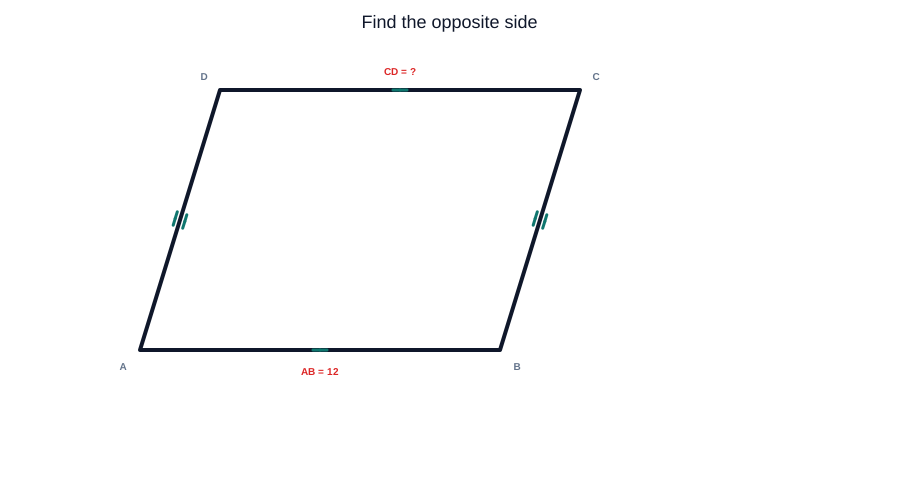
Unworked quadrilateral configuration showing only the supplied evidence. Open full size
Your answer
Show answer choicesAnswer choices Work through the mathematics first, then compare your reasoning.Select the answer that matches your work.
Answer choices
With a free account

Turn a few problems into a learning session.

Choose a course and objective, collect included problems into a session, and work through them in order.

Create a free account
With paid access

Take the session to paper.

Export learning sessions as spacious printable PDFs when pencil-and-paper practice works better.

Compare plans

Hint

Use the parallelogram property that opposite sides have equal length.

In parallelogram \(ABCD\), side \(AB\) is opposite side \(CD\), so \(AB=CD\).

Solution walkthrough

01

Verify the opposite-side pairing

\[\begin{aligned} \text{boundary}~\text{order}~A-B-C-D \\ AB~\text{is}~\text{opposite}~CD \end{aligned}\]

Sides AB and CD share no endpoint and lie across the parallelogram from one another, as the inspected labels and matching marks show.

02

Apply the parallelogram side theorem

\[AB=CD\]

Opposite sides of a parallelogram are congruent.

03

Substitute the known length

\[AB=12~->~CD=12\]

The given length transfers directly to its opposite side.

04

Check the named pair

\[AB=CD=12\]

The equality uses the correct one-mark opposite pair, not the adjacent double-mark pair AD and BC.

+

Another way

  1. Use a diagonal to form congruent triangles and recover the opposite-side equality.

!

Common mistake

Do not use an adjacent side. The congruent partner of AB is the side directly opposite it, CD.

Completed quadrilateral diagram with decisive theorem evidence and conclusion.
CD = 12