All courses Math II · G-CO.9 36 of 73
Prove theorems about lines and angles: vertical angles, parallel-line angle relationships, and perpendicular bisectors.

Use vertical angles to find a missing angle measure or variable

Problem
Given one vertical angle is 72 degrees, use vertical angles to find the missing angle measure.
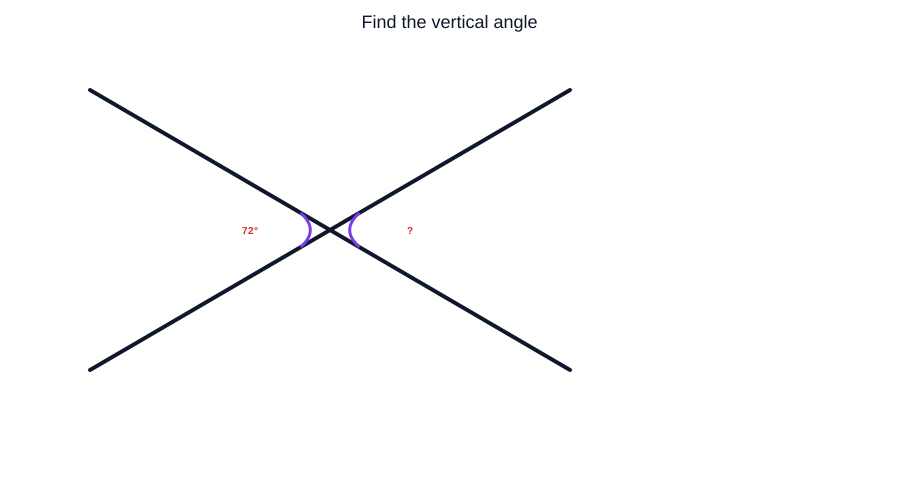
Unworked line or perpendicular-bisector configuration showing only supplied evidence. Open full size
Your answer
Show answer choicesAnswer choices Work through the mathematics first, then compare your reasoning.Select the answer that matches your work.
Answer choices
With a free account

Choose exactly what to practice.

Browse the learning objectives and included problem types, then build a session around the math you want to work on.

Create a free account
With paid access

Make a more precise practice set.

Choose from the complete range of objectives and problem types in your subscribed course when building a session.

Compare plans

Hint

Identify the missing angle as the angle directly opposite the 72 degree angle. Opposite angles formed by intersecting lines are vertical angles.

Vertical angles are congruent, so they have the same measure. Do not subtract from 180 unless the angles are adjacent and form a linear pair.

Solution walkthrough

01

Identify the pair by position

\[\text{known}~\text{and}~\text{unknown}~\text{angles}~\text{lie}~\text{opposite}~\text{at}~\text{one}~\text{intersection}\]

Opposite nonadjacent regions formed by the same two intersecting lines are vertical angles.

02

Apply the vertical angles theorem

\[\text{vertical}~\text{angles}~\text{are}~\text{congruent}\]

The theorem gives equal measures, not a supplementary relationship.

03

Transfer the measure

\[\text{missing}~\text{angle}=72~\text{degrees}\]

The angle directly opposite the given 72-degree region has the same measure.

04

Distinguish the adjacent case

\[\text{adjacent}~\text{angles}=180-72=108~\text{degrees}\]

This check explains why 108 belongs to a linear-pair region, not the requested vertical angle.

+

Another way

  1. Label the opposite regions 1 and 3 and use m angle 1=m angle 3.

!

Common mistake

Do not subtract from 180; that finds an adjacent angle rather than the opposite vertical angle.

Completed line or perpendicular-bisector diagram with theorem evidence and conclusion.
72°