All courses Math III · G-MG.3 41 of 55
Use geometric methods to solve design problems under constraints such as cost, space, or ratios.

Model and maximize fixed-fencing rectangle area

Problem
A rectangle has perimeter 40 units. Let one side be x.
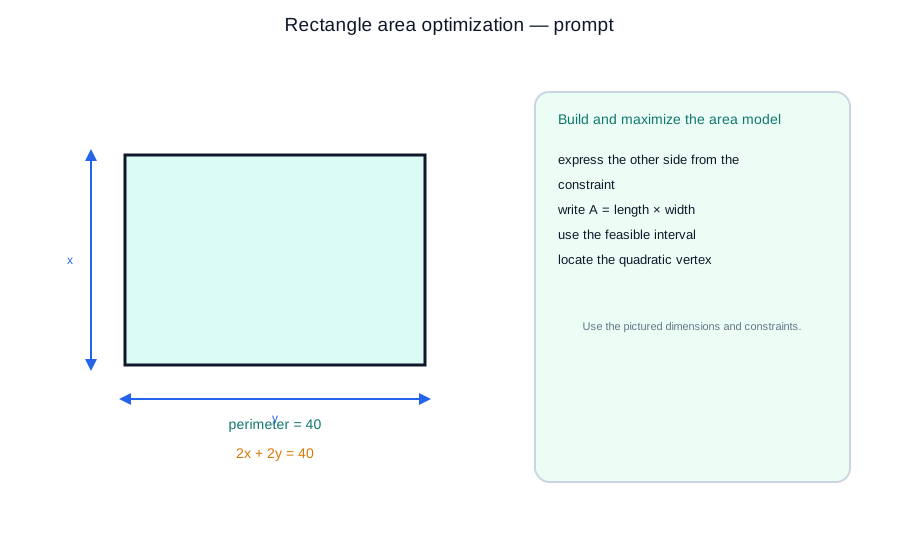
A dimensioned rectangle shows side lengths x and y and a fixed perimeter of 40; the area model and maximizing dimensions are withheld. Open full size
Your answer
Choose an answer
With a free account

Explore all four courses.

Starter practice spans Math Foundations and Math I–III, so you can find the level and objective you need.

Create a free account
With paid access

Follow a skill back to its prerequisites.

All-course access lets you move between Math Foundations and Math I–III when an earlier idea needs attention.

Compare plans

Hint

Draw and label how many sides have length x and how many have length y.

Translate fencing into a linear constraint, solve for y, substitute into A=xy, restrict both dimensions positive, then find the quadratic vertex.

Solution walkthrough

01

Write fencing constraint

\[2x+2y=40~->~y=20-x\]

Side multiplicities differ for a four-sided enclosure and a wall-backed three-sided pen.

02

Build model and domain

\[A(x)=x(20-x);~0<x<20\]

Substitute y into xy and require x>0,y>0.

03

Find quadratic vertex

\[\text{maximizing}~\text{input}=x=10\]

The area parabola opens downward, so its vertex is the global interior maximum.

04

Recover dimensions and area

\[10~\text{by}~10~\text{units};~100~\text{square}~\text{units}\]

Substitute the optimizer into the eliminated dimension and area model.

05

Submit all fields

\[\text{constraint}=2x+2y=40~->~y=20-x;~\text{area}~\text{model}=A(x)=x(20-x);~\text{feasible}~\text{domain}=0<x<20;~\text{maximizing}~\text{input}=x=10;~\text{dimensions}=10~\text{by}~10~\text{units};~\text{maximum}~\text{area}=100~\text{square}~\text{units}\]

Constraint, feasibility, and optimization are separately checkable.

+

Another way

  1. Complete the square in A(x) to display the maximum value directly.

!

Common mistake

Do not count the wall as fencing or allow zero-length boundary designs.

The rectangle constraint is converted to A equals x times 20 minus x, with a downward parabola whose vertex gives a 10 by 10 maximum.