All courses Math III · G-SRT.10 42 of 55
Prove the Laws of Sines and Cosines and use them to solve problems.

Use the Law of Sines to find a missing side from two angles and one opposite side

Problem
Use the Law of Sines to find the missing side in this triangle: A = 30 degrees, B = 45 degrees, a = 10, find b.
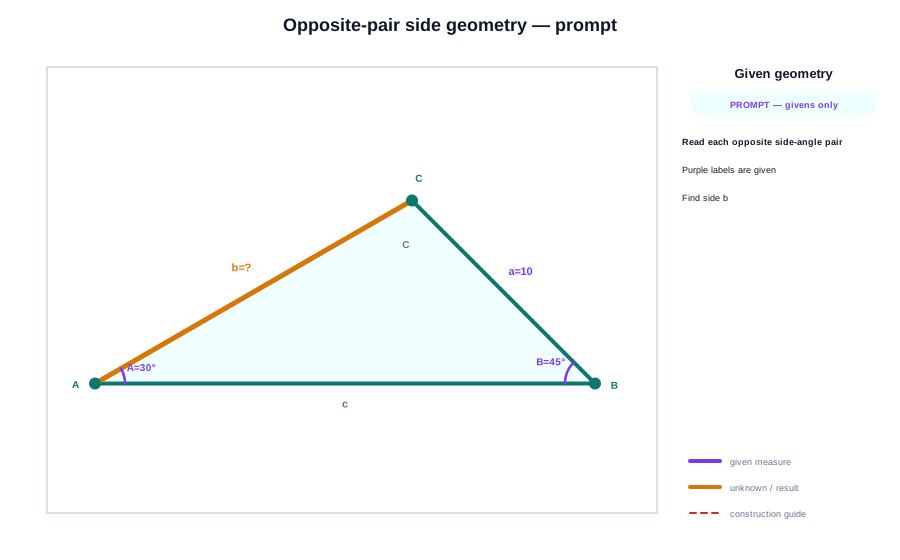
A scale-faithful triangle marking the two given angles, known opposite side, and requested side without a solved value. Open full size
Your answer
Choose an answer
With a free account

Keep a practice history.

Completed and unfinished sessions remain in your history, ready to review whenever you need them.

Create a free account
With paid access

Separate understanding from one lucky answer.

Multiple variants of a problem type let you apply the method again before deciding that the skill is secure.

Compare plans

Hint

Start by matching each side with its opposite angle in the Law of Sines: \(\frac{a}{\sin A}=\frac{b}{\sin B}\). Then plug in \(a=10\), \(A=30^\circ\), and \(B=45^\circ\).

Use the Law of Sines: \(\frac{a}{\sin A}=\frac{b}{\sin B}\). Here, side \(a\) goes with angle \(A=30^\circ\), and side \(b\) goes with angle \(B=45^\circ\).

Solution walkthrough

01

Set up the Law of Sines

\[\frac{a}{\sin~A}~=~\frac{b}{\sin~B}\]

Because you know two angles and one side, the Law of Sines is the right relationship to use. It connects each side to the sine of its opposite angle.

02

Substitute the given values

\[\frac{10}{\sin~30^\circ}~=~\frac{b}{\sin~45^\circ}\]

Replace \(a\) with 10, \(A\) with \(30^\circ\), and \(B\) with \(45^\circ\). Now the only unknown is \(b\).

03

Solve for \(b\)

\[b~=~\frac{10\sin~45^\circ}{\sin~30^\circ}~=~\frac{10~\left(\frac{\sqrt{2}}{2}\right)}{\frac{1}{2}}~=~10\sqrt{2}\]

Multiply both sides by \(\sin 45^\circ\) to isolate \(b\). Then use the exact trig values \(\sin 45^\circ=\frac{\sqrt{2}}{2}\) and \(\sin 30^\circ=\frac{1}{2}\).

04

State the missing side

\[b~=~10\sqrt{2}\]

The missing side is \(b=10\sqrt{2}\), which is about 14.1 units.

+

Another way

  1. You can cross-multiply first: \(10\sin 45^\circ=b\sin 30^\circ\), then divide by \(\sin 30^\circ\) to get the same result.

  2. Check whether the answer makes sense: angle \(B=45^\circ\) is larger than angle \(A=30^\circ\), so side \(b\) should be longer than side \(a=10\). Since \(10\sqrt{2}\approx 14.1\), the result is reasonable.

!

Common mistake

A common mistake is matching the wrong side with the wrong angle, such as using \(\frac{10}{\sin 45^\circ}=\frac{b}{\sin 30^\circ}\). In the Law of Sines, each side must be paired with its opposite angle: \(a\) with \(A\), and \(b\) with \(B\).

The same labeled triangle with the missing side solved as b=10√2≈14.14.
The labeled triangle gives b=10√2≈14.14 by the Law of Sines.