All courses Math Foundations · MF.GR.6 45 of 60
Interpret intercepts and starting values in contextual linear situations.

Find the starting value

Problem
The table contains the points (0, 18), (2, 24), and (4, 30). Which option gives the starting y-value?
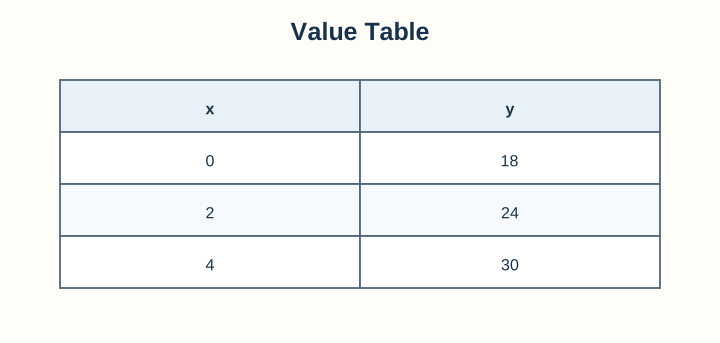
Value Table: x and y with 3 rows. Open full size
Your answer
Choose an answer
With a free account

Turn a few problems into a learning session.

Choose a course and objective, collect included problems into a session, and work through them in order.

Create a free account
With paid access

Build sessions from the full problem bank.

Choose the objective you need and make a learning session using all of its available problem types and variants.

Compare plans

Hint

Find the row in the table where x = 0.

The starting value is the y-value paired with x = 0.

Solution walkthrough

01

Recall what the starting value means

\[\text{starting}~\text{value}~=~y~\text{when}~x~=~0\]

In a table of x and y values, the starting value is the output at the moment the input is 0.

02

Find the row with input 0

\[0~|~18\]

The table row where x = 0 is the one that shows the start.

03

Read the matching output

\[x~=~0~\text{pairs}~\text{with}~y~=~18\]

Once you find x = 0, the y-value in that same row is the starting value.

04

State the starting value

\[18\]

The table starts at 18 because the output is 18 when the input is 0.

+

Another way

  1. You can read the first row as the ordered pair (0, 18). In the point (0, 18), the output when the input is 0 is 18, so the starting value is 18.

!

Common mistake

Reporting the rate of change instead of the starting value. For example, the y-values go up by 6 when x goes up by 2, but 6 is not the starting value. The starting value is the y-value when x = 0, which is 18.