All courses Math Foundations · MF.GR.7 46 of 60
Match and compare words, tables, graphs, and simple equations that represent the same relationship.

Match a table to its rule

Problem
A table maps x-values 0, 1, 2, 3 to y-values 2, 6, 10, 14. Determine the equation represented by the table.
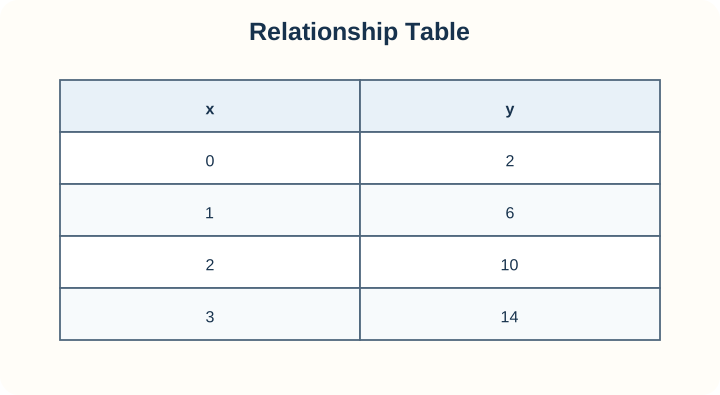
Relationship Table: x and y with 4 rows. Open full size
Your answer
Choose an answer
With a free account

Keep complete walkthroughs close.

Every problem included with your account keeps its hints and full solution walkthrough available for review.

Create a free account
With paid access

Try the same skill with new numbers.

More variants let you check whether you understand the method instead of remembering one answer.

Compare plans

Hint

Look at the row where x = 0 to find the starting value, then check how much y increases each time x goes up by 1.

A table and an equation match only if they have the same starting value and the same rate of change.

Solution walkthrough

01

Read the starting value from the table

\[x~=~0~\text{gives}~y~=~2\]

In a linear rule, the value of y when x = 0 is the starting value. So this relationship starts at 2.

02

Find the rate of change

\[2~→~6~→~10~→~14~=~+4~\text{each}~\text{time}~x~\text{increases}~\text{by}~1\]

The y-values go up by 4 for every increase of 1 in x, so the rule must have a rate of 4.

03

Compare the table to each equation

\[\begin{aligned} A:~y~=~4x~+~2~\text{has}~\text{rate}~4~\text{and}~\text{start}~2 \\ B:~y~=~2x~+~4~\text{has}~\text{rate}~2~\text{and}~\text{start}~4 \\ C:~y~=~4x~\text{has}~\text{rate}~4~\text{and}~\text{start}~0 \\ D:~y~=~x~+~2~\text{has}~\text{rate}~1~\text{and}~\text{start}~2 \end{aligned}\]

Only choice A matches both important parts of the table: it starts at 2 and increases by 4 each step.

04

Choose and verify the match

\[\text{For}~A,~x~=~3~\text{gives}~y~=~4(3)~+~2~=~14\]

That matches the table value 14 when x = 3, so the correct equation is A, y = 4x + 2.

+

Another way

  1. Substitute a few table x-values into choice A: x = 0 gives 2, x = 1 gives 6, and x = 2 gives 10. Since it matches every shown row, A is the correct rule.

!

Common mistake

Choosing y = 4x because the y-values are close to multiples of 4. That rule has starting value 0, but the table shows y = 2 when x = 0, so it does not match.