All courses Algebra I · F-LE.1.a 28 of 76
Distinguish linear from exponential situations by equal differences versus equal factors over equal intervals.

Use first differences to identify a linear pattern

Problem
Calculate the first differences in the table. Are they constant? Use the differences to decide whether the pattern is linear.
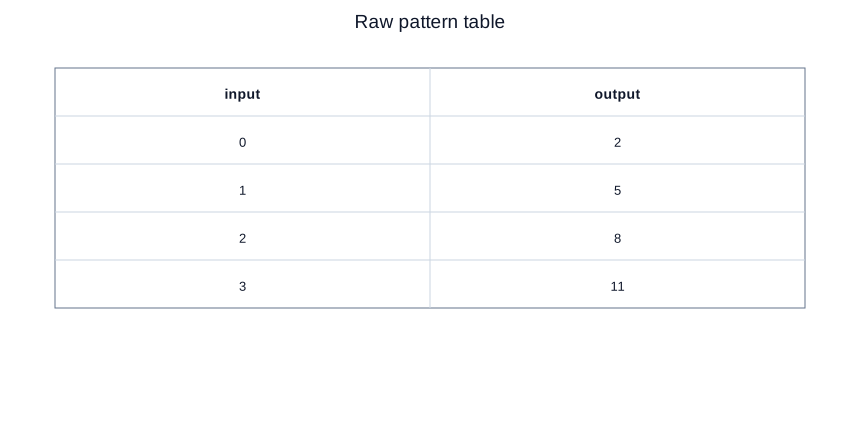
Raw input/output table without computed differences, ratios, or classification cues. Open full size
Your answer
Show answer choicesHide answer choices Work through the mathematics first, then compare your reasoning.Select the answer that matches your work.
Answer choices
With a free account

Take your practice with you.

Sign in on the web or in the iPhone and iPad app to use the same saved sessions and results.

Create a free account
With paid access

Learn from every walkthrough.

Unlock the complete problem bank, its written solutions, and its step-by-step learning videos—not only the walkthroughs in the starter set.

Compare plans

Hint

Subtract consecutive outputs to find the first differences: \(5-2\), \(8-5\), and \(11-8\).

A pattern is linear when the first differences are constant over equal input intervals.

Solution walkthrough

01

Read the table in input order

\[\text{inputs}:~0,1,2,3;~\text{outputs}:~2,5,8,11\]

The inspected table uses equal one-unit input intervals, so consecutive output differences can test whether the pattern is linear.

02

Compute every first difference

\[5-2=3;~8-5=3;~11-8=3\]

Each subtraction uses the later output minus the preceding output. Every first difference equals positive 3.

03

Apply the linear test

\[\text{equal}~\text{input}~\text{steps}~+~\text{constant}~\text{first}~\text{difference}~3~->~\text{linear}\]

A constant output difference over equal input intervals is decisive evidence of a linear pattern. The positive difference also shows the outputs increase.

04

Report the requested evidence

\[\text{linear};~\text{differences}:~3,~3,~3\]

The classification and the three independently computed differences exactly answer the prompt.

+

Another way

  1. The outputs fit y=3x+2 for every displayed input, another confirmation that the pattern is linear.

!

Common mistake

Do not reverse the subtraction order. Reading downward in the table requires later output minus earlier output, giving 5-2=3 rather than -3.

First-differences pattern card showing outputs 2, 5, 8, 11 with cues to subtract consecutive outputs and check whether the differences match.
classification: linear; differences: 3, 3, 3

Solution walkthrough video