All courses Algebra I · A-SSE.1.b 55 of 76
Interpret quadratic/exponential expressions by treating sub-expressions as meaningful units.

Connect solutions of f(x) = g(x) to graph intersections

Problem
Use the displayed graph to interpret \((x-4)^{2}\) in \(f(x)=(x-4)^{2}+7\). Identify the center, signed difference, absolute distance, squared-distance term, and why inputs equally far on opposite sides have equal outputs.
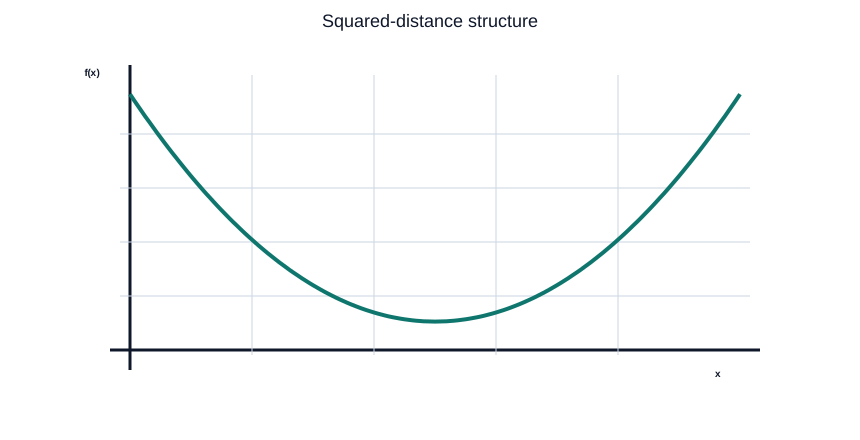
Unannotated graph of f(x)=(x−4)²+7; the parabola is shown without naming its center, symmetry axis, or equal-output inputs. Open full size
Your answer
Show answer choicesHide answer choices Work through the mathematics first, then compare your reasoning.Select the answer that matches your work.
Answer choices
With a free account

Stop now. Continue later.

A saved learning session lets you leave when you need to and return without losing your place.

Create a free account
With paid access

Use the screen to choose. Use paper to solve.

Build the exact session you want online, then export it as a printable worksheet.

Compare plans

Hint

Rewrite the inside as variable−center.

(x−h) is signed displacement from h, |x−h| is distance, and (x−h)² gives equal values at h±d.

Solution walkthrough

01

Treat the binomial as a signed difference

\[\begin{aligned} f(x)=(x-4)^2+7 \\ \text{center}~h=4;~\text{signed}~\text{difference}=x-4 \end{aligned}\]

Vertex form uses x-h, so x-4 measures the signed horizontal displacement from the center input 4.

02

Convert signed difference to distance

\[\text{distance}~\text{from}~4=|x-4|\]

Distance is nonnegative, so the absolute value removes whether x lies left or right of 4.

03

Interpret the squared-distance term

\[\text{squared}~\text{distance}=(x-4)^2\]

Squaring x-4 also removes its sign. This term measures the square of the horizontal distance from the center.

04

Explain symmetric equal outputs

\[\begin{aligned} x=4-d~->~(x-4)^2=(-d)^2=d^2 \\ x=4+d~->~(x-4)^2=d^2 \end{aligned}\]

Inputs equally far on opposite sides produce the same squared-distance term and therefore the same output. The inspected answer graph marks this symmetry about x=4.

+

Another way

  1. Substitute the symmetric inputs 4-d and 4+d directly and compare their outputs.

!

Common mistake

Do not read x-4 as a center of -4, and do not call signed x-4 a distance without absolute value.

Annotated graph of f(x)=(x−4)²+7: center 4, symmetry axis x=4, signed displacement x−4, distance |x−4|, squared-distance term (x−4)², and inputs 4−d and 4+d have equal outputs.
center=4; signed difference=x−4; distance=|x−4|; squared-distance term=(x−4)²; symmetry consequence=inputs4−d and4+d give equal outputs

Solution walkthrough video