All courses Algebra I · F-LE.3 72 of 76
Compare growth of exponential, linear, quadratic, and other polynomial models using graphs/tables.

Compare linear and exponential table growth precisely

Problem
Analyze the table for \(n=0,1,2,3\). Compute consecutive differences for \(L\) and consecutive ratios for \(E\), record the leader or tie at each listed \(n\), then extend \(\text{both}~\text{patterns}\) to \(n=4\) and identify the first overtake after the table.
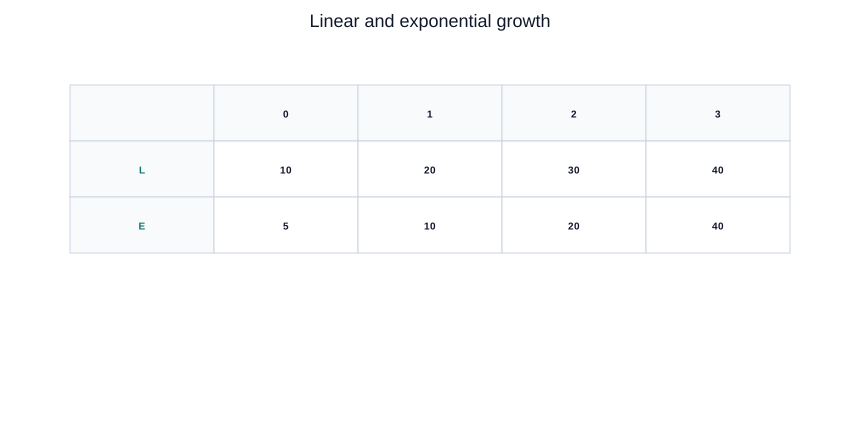
Source table for n=0,1,2,3: L values 10,20,30,40 and E values 5,10,20,40. Open full size
Your answer
Show answer choicesHide answer choices Work through the mathematics first, then compare your reasoning.Select the answer that matches your work.
Answer choices
With a free account

Read the steps or watch the work.

Every problem included with your free account keeps its hints, complete written solution, and step-by-step learning video available for review.

Create a free account
With paid access

Learn from every walkthrough.

Unlock the complete problem bank, its written solutions, and its step-by-step learning videos—not only the walkthroughs in the starter set.

Compare plans

Hint

Compute consecutive differences for L and ratios for E.

Linear tables have a constant difference; exponential tables have a constant nonunit factor.

Solution walkthrough

01

Compute L's differences

\[20-10=10;~30-20=10;~40-30=10\]

Equal first differences show that L adds 10 at each step.

02

Compute E's ratios

\[10/5=2;~20/10=2;~40/20=2\]

Equal ratios show that E multiplies by 2 at each step.

03

Record the table leaders

\[n=0:~L;~n=1:~L;~n=2:~L;~n=3:~\text{tie}\]

Comparing each column gives 10>5, 20>10, 30>20, and 40=40.

04

Extend and identify the overtake

\[\begin{aligned} n=4:~L=40+10=50;~E=40*2=80 \\ E~\text{first}~\text{overtakes}~\text{after}~\text{table} \end{aligned}\]

Continuing each established pattern one step makes E exceed L immediately after the tie.

+

Another way

  1. Write rules L(n)=10+10n and E(n)=5(2ⁿ), then evaluate n=4.

!

Common mistake

Do not extend E by adding 20. Its invariant is a ratio of 2, so 40 becomes 80.

Answer comparison: L has constant difference +10; E has factor 2. Leaders are L,L,L,tie for n=0–3; at n=4, L=50 and E=80, so E first overtakes after the table.
L model=linear; L constant difference=+10; E model=exponential; E constant factor=×2; listed leader sequence=L,L,L,tie; first listed equality=n=3; first listed overtake=none; next-row check n=4:L=50,E=80; first overtake after table=E at n=4; eventual dominance=E

Solution walkthrough video