All courses Algebra II · F-IF.7.b 31 of 55
Graph square-root, cube-root, absolute-value, step, and piecewise-defined functions.

Graph a transformed square root from exact anchor rows

Problem
For \(y~=~\sqrt{x~-~2}~+~1\), state \(a\), \(h\), and \(k\); give the endpoint, domain, and range; and map the parent square-root anchors with inputs \(1\), \(4\), and \(9\).
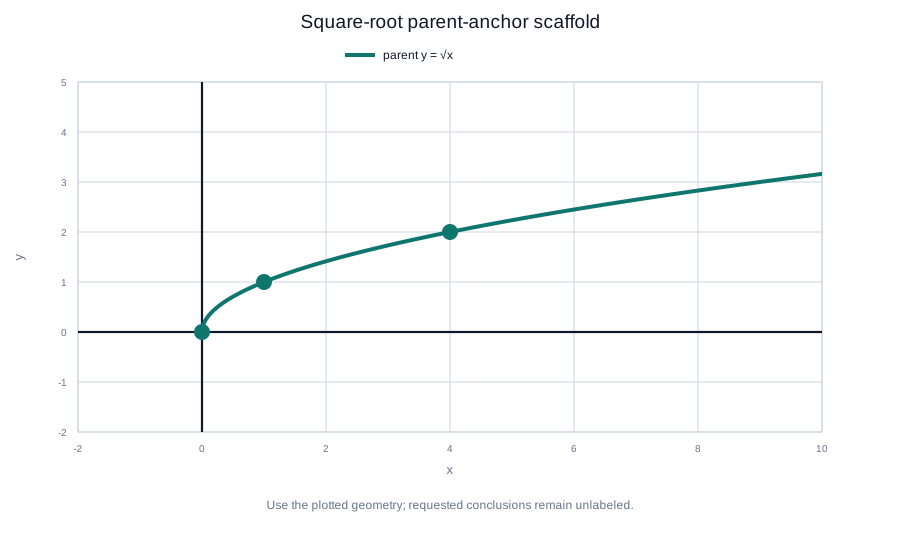
Parent square-root graph with standard anchor dots on a coordinate grid. Open full size
Your answer
Show answer choicesHide answer choices Work through the mathematics first, then compare your reasoning.Select the answer that matches your work.
Answer choices
With a free account

Practice the problem type you meant to practice.

Navigate by objective and problem type instead of taking whichever free problem happens to come next.

Create a free account
With paid access

Give your progress record more evidence.

A larger problem bank gives you more chances to see whether a skill is becoming dependable.

Compare plans

Hint

Identify a,h,k and solve x-h=r for each selected radicand r.

For y=a√(x-h)+k, endpoint is (h,k); use radicands 0,1,4,9 for easy exact anchors.

Solution walkthrough

01

Read transformation parameters

\[y=a*\sqrt{x-h}+k~->~a=1,~h=2,~k=1\]

Comparing y=sqrt(x-2)+1 with standard form shows no reflection or vertical scaling, a right shift of 2, and an upward shift of 1.

02

Find endpoint and sets

\[x-h=0~->~x=2;~y=1~->~\text{endpoint}~(2,1);~\text{domain}~[2,\text{infinity});~\text{range}~[1,\text{infinity})\]

The principal square-root graph begins where its radicand is zero. With a positive scale, that endpoint also gives the minimum input and output.

03

Map exact parent anchors

\[\text{radicand}~1~->~(3,2);~4~->~(6,3);~9~->~(11,4)\]

For each parent input u, transformed x=u+2 and y=sqrt(u)+1. The supplied perfect squares keep all anchor outputs exact.

04

State the complete graph data

\[\text{Parameters}:~a=1,~h=2,~k=1.~\text{Endpoint}:~(2,1).~\text{Domain}:~[2,\text{infinity}).~\text{Range}:~[1,\text{infinity}).~\text{Anchors}:~(3,2),~(6,3),~(11,4).\]

These parameters, endpoint, sets, and three mapped anchors uniquely specify the transformed square-root graph, choice A.

+

Another way

  1. Set u=x-2, map the parent points (u,sqrt(u)), then use x=u+2 and y=sqrt(u)+1.

!

Common mistake

The expression x-2 shifts the graph right 2, not left. Map parent inputs by adding 2 to x and add 1 to each parent output.

Square-root graph shifted to endpoint 2 comma 1 and passing through 3 comma 2.
Endpoint (2, 1); anchor (3, 2); domain x ≥ 2; range y ≥ 1.

Solution walkthrough video