All courses Algebra II · F-TF.2 41 of 55
Use the unit circle to extend trig functions to all real-number radian measures.

Find cos(θ) and sin(θ) from a point on the unit circle

Problem
If a point on the unit circle is \((1/2,\sqrt{3}/2)\), what are \(\cos(\theta)\) and \(\sin(\theta)\)?
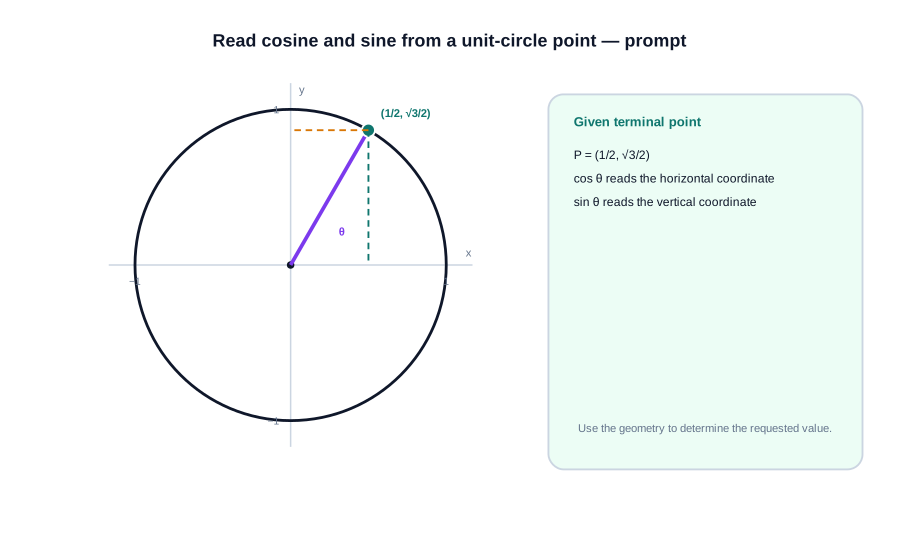
Neutral method card that does not show the requested result or terminal position. Open full size
Your answer
Show answer choicesHide answer choices Work through the mathematics first, then compare your reasoning.Select the answer that matches your work.
Answer choices
With a free account

Practice the problem type you meant to practice.

Navigate by objective and problem type instead of taking whichever free problem happens to come next.

Create a free account
With paid access

Give your progress record more evidence.

A larger problem bank gives you more chances to see whether a skill is becoming dependable.

Compare plans

Hint

On the unit circle, the x-coordinate is cos(theta) and the y-coordinate is sin(theta).

Match the first coordinate to cosine and the second coordinate to sine; do not swap the coordinate order.

Solution walkthrough

01

Use the unit-circle coordinate definition

\[(x,y)=(\cos(\theta),\sin(\theta))\]

A terminal point on the unit circle records cosine as its x-coordinate and sine as its y-coordinate.

02

Read the two coordinates

\[x=1/2~\text{and}~y=\sqrt{3}/2\]

The given terminal point is (1/2,sqrt(3)/2), so these are the cosine and sine values respectively.

03

Check that the point is on the unit circle

\[x^2+y^2=(1/2)^2+(\sqrt{3}/2)^2=1/4+3/4=1\]

The coordinates satisfy the unit-circle equation, confirming that the values are consistent.

04

State cosine and sine

\[\cos(\theta)~=~1/2,~\sin(\theta)~=~\sqrt{3}/2\]

Cosine is the horizontal coordinate and sine is the vertical coordinate of the terminal point.

+

Another way

  1. Recognize the point as the standard pi/3 unit-circle point and recall cos(pi/3)=1/2 and sin(pi/3)=sqrt(3)/2.

!

Common mistake

Do not reverse the coordinates. On the unit circle, cosine is x and sine is y.

Answer diagram for M3-034-A01-V01: the same geometry with cosine and sine identified as the x- and y-coordinates.

Solution walkthrough video