All courses Geometry · G-MG.3 54 of 57
Use geometric methods to solve design problems under constraints such as cost, space, or ratios.

Model and maximize fixed-fencing rectangle area

Problem
A rectangle has perimeter \(40~\text{units}\), and \(\text{one}~\text{side}\) is \(x\). Use the diagram to build a \(\text{one}\text{-}\text{variable}\) area model with its positive feasible domain, then find the maximizing dimensions and maximum area.
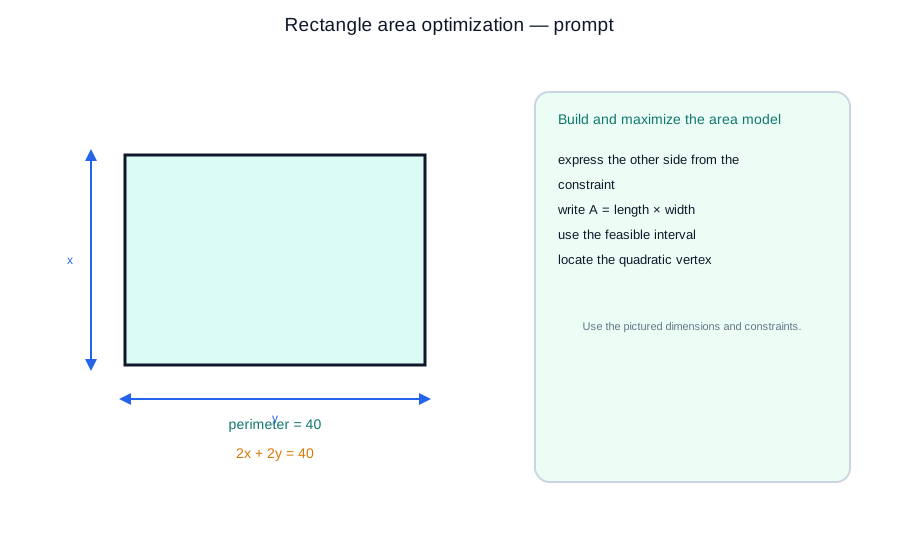
Prompt rectangle with sides x and y and fixed perimeter 40, so 2x+2y=40; the area model, feasible domain, optimizer, dimensions, and maximum area are withheld. Open full size
Your answer
Show answer choicesHide answer choices Work through the mathematics first, then compare your reasoning.Select the answer that matches your work.
Answer choices
With a free account

Explore all four courses.

Starter practice spans Math Foundations and Math I–III, so you can find the level and objective you need.

Create a free account
With paid access

Follow a skill back to its prerequisites.

All-course access lets you move between Math Foundations and Math I–III when an earlier idea needs attention.

Compare plans

Hint

Draw and label how many sides have length x and how many have length y.

Translate fencing into a linear constraint, solve for y, substitute into A=xy, restrict both dimensions positive, then find the quadratic vertex.

Solution walkthrough

01

Use the perimeter constraint

\[2x+2y=40~->~x+y=20~->~y=20-x\]

The diagram labels the rectangle sides x and y. Solving the fixed-perimeter equation expresses y using x alone.

02

Build the one-variable area model

\[A=x*y~->~A(x)=x(20-x)=-x^2+20x\]

Substitute y=20-x into length times width.

03

State the positive feasible domain

\[x>0~\text{and}~20-x>0~->~0<x<20\]

Both side lengths must be positive; the endpoints would collapse the rectangle to zero area.

04

Find the quadratic maximum

\[A(x)=-(x-10)^2+100\]

Completing the square shows a downward-opening parabola whose vertex occurs at x=10 with area 100.

05

Recover dimensions and conclude

\[x=10;~y=20-10=10.~\text{From}~2x~+~2y~=~40,~y~=~20~-~x~\text{and}~A(x)~=~x(20~-~x),~\text{with}~0~<~x~<~20.~\text{The}~\text{maximum}~\text{occurs}~\text{at}~x~=~10,~\text{giving}~a~10-by-10~\text{rectangle}~\text{with}~\text{area}~100~\text{square}~\text{units}.\]

The dimensions satisfy the perimeter check 2(10)+2(10)=40 and give the model's maximum.

+

Another way

  1. Use the vertex formula for A=-x²+20x: x=-b/(2a)=-20/(-2)=10, then find y and area.

!

Common mistake

Do not optimize x(40-x). The perimeter counts each side twice, so x+y=20 and the other side is 20-x.

Answer rectangle with 2x+2y=40, so y=20-x and A=x(20-x) on 0<x<20; the downward parabola has vertex x=10, giving dimensions 10 by 10 and maximum area 100 square units.

Solution walkthrough video