All courses Math Foundations · MF.PR.4 18 of 60
Use ratio tables and double number lines to solve missing-value and scaling problems.

Complete a ratio table entry

Problem
Use the ratio table to find the missing number.
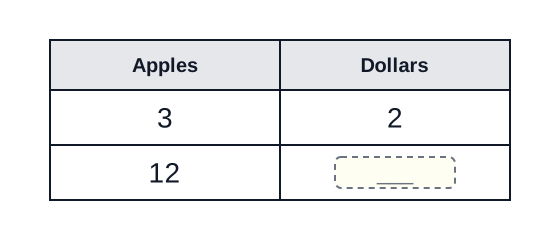
Ratio table with columns Apples and Dollars. The first row shows 3 apples and 2 dollars. The second row shows 12 apples and a blank dollar value. Open full size
Your answer
Show answer choicesHide answer choices Work through the mathematics first, then compare your reasoning.Select the answer that matches your work.
Answer choices
With a free account

Stop now. Continue later.

A saved learning session lets you leave when you need to and return without losing your place.

Create a free account
With paid access

Learn from every walkthrough.

Unlock the complete problem bank, its written solutions, and its step-by-step learning videos—not only the walkthroughs in the starter set.

Compare plans

Hint

Look at the apples column first: how do you get from 3 apples to 12 apples?

In a ratio table, both entries in a row must scale by the same multiplicative factor to keep the ratio equivalent.

Solution walkthrough

01

Read the known and target rows

\[3~\text{apples}~=~\$2;~12~\text{apples}~=~?~\text{dollars}\]

The inspected table pairs 3 apples with 2 dollars and leaves the dollar value for 12 apples blank.

02

Find the apple scale factor

\[12~/~3~=~4\]

The number of apples is multiplied by 4.

03

Scale dollars by the same factor

\[\$2~\times~4~=~\$8\]

Using the same factor preserves the apples-to-dollars ratio.

04

Check and fill the blank

\[8\]

The completed pair is 12 apples for 8 dollars; dividing both terms by 4 returns 3 apples for 2 dollars.

+

Another way

  1. Find the cost per apple, $2/3, then multiply by 12 to get $8.

!

Common mistake

Do not add 9 to the dollar amount because apples increased by 9. Proportional tables use multiplicative scaling.

Solution walkthrough video