All courses Algebra II · A-APR.5 12 of 55
Apply the Binomial Theorem for expanding (x+y)^n using Pascal's Triangle or combinatorial reasoning.

Expand a binomial power using Pascal's Triangle

Problem
Use Pascal's Triangle to expand \((x~+~y)^4\).
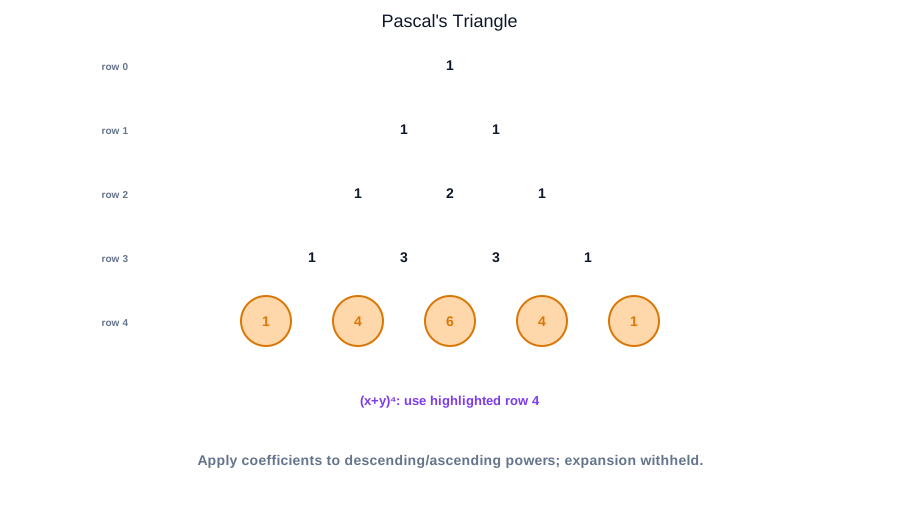
Pascal's Triangle through row 4, with row 4 highlighted as 1, 4, 6, 4, 1 for (x+y)^4. Apply these coefficients to descending powers of x and ascending powers of y; the expansion is withheld. Open full size
Your answer
Show answer choicesHide answer choices Work through the mathematics first, then compare your reasoning.Select the answer that matches your work.
Answer choices
With a free account

See progress instead of guessing.

Gozunta keeps your results together so you can see what you have practiced and how it went.

Create a free account
With paid access

Keep going when the starter set ends.

A subscription removes the locked gaps from your selected course so practice can continue through the full sequence.

Compare plans

Hint

Use the Pascal's Triangle row for power \(4\): \(1, 4, 6, 4, 1\).

The powers of \(x\) decrease from \(4\) to \(0\), while the powers of \(y\) increase from \(0\) to \(4\).

Solution walkthrough

01

Select the row for exponent four

\[n=4~->~\text{coefficients}~1,4,6,4,1\]

Pascal's Triangle row 4 supplies five coefficients for a fourth-power binomial. The inspected source visual highlights exactly 1, 4, 6, 4, 1.

02

Build the complementary power pattern

\[x^4y^0,~x^3y^1,~x^2y^2,~x^1y^3,~x^0y^4\]

Across the five terms, the exponent of x decreases from 4 to 0 while the exponent of y increases from 0 to 4. Each pair sums to the total exponent 4.

03

Attach each coefficient to its term

\[1x^4+4x^3y+6x^2y^2+4xy^3+1y^4\]

Match the Pascal coefficients in order with the five power products. Powers of zero reduce the first and last products to x⁴ and y⁴.

04

Write and check the full expansion

\[x^4~+~4x^3y~+~6x^2y^2~+~4xy^3~+~y^4\]

The coefficients are symmetric and sum to 16, which agrees with evaluating (1+1)⁴=16. The expansion is x⁴+4x³y+6x²y²+4xy³+y⁴, choice A.

+

Another way

  1. Apply the Binomial Theorem sum from k=0 to 4 using coefficient 4Ck and term x⁴⁻kyk.

!

Common mistake

Do not use the coefficients without the complementary exponent pattern. The x power decreases by one while the y power increases by one in every successive term.

x⁴ + 4x³y + 6x²y² + 4xy³ + y⁴

Solution walkthrough video