All courses Algebra II · A-APR.6 13 of 55
Rewrite rational expressions using inspection, polynomial division, or technology.

Divide polynomials using long division

Problem
Use the polynomial long-division setup to divide \(x^3~+~2x^2~-~5x~+~6\) by \(x~+~3\). State the quotient and remainder.
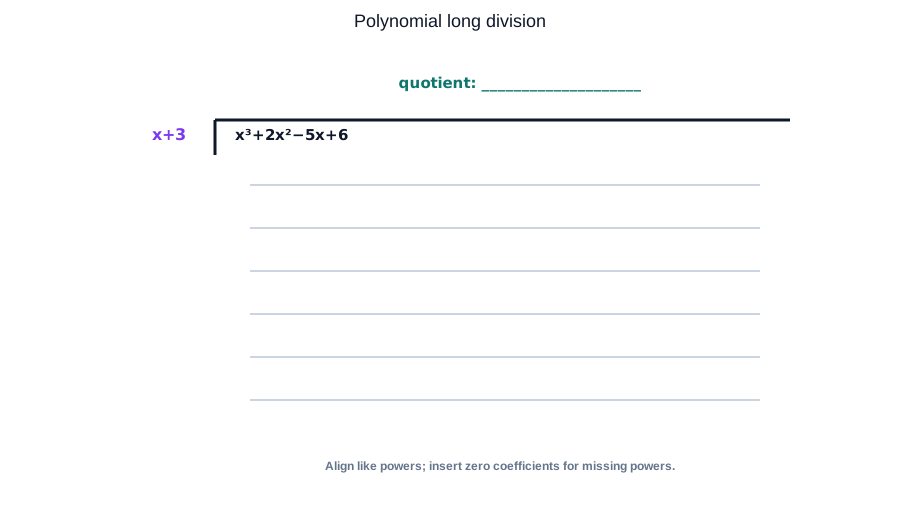
Unsolved polynomial long-division scaffold with divisor x+3 and dividend x^3+2x^2-5x+6. The quotient line and all subtract-and-bring-down work are blank; align like powers. Quotient and remainder are withheld. Open full size
Your answer
Show answer choicesHide answer choices Work through the mathematics first, then compare your reasoning.Select the answer that matches your work.
Answer choices
With a free account

Read the steps or watch the work.

Every problem included with your free account keeps its hints, complete written solution, and step-by-step learning video available for review.

Create a free account
With paid access

Follow a skill back to its prerequisites.

All-course access lets you move between Math Foundations and Math I–III when an earlier idea needs attention.

Compare plans

Hint

Divide the leading term \(x^3\) by the leading term \(x\) to get the first quotient term.

In long division, divide, multiply, subtract, and then bring down the next term.

Solution walkthrough

01

Divide the leading terms

\[x^3/x=x^2\]

The dividend x³+2x²-5x+6 is already in descending powers. Dividing its leading term by the divisor's leading term gives the first quotient term x².

02

Multiply and subtract the first row

\[(x^3+2x^2-5x+6)-(x^3+3x^2)=-x^2-5x+6\]

Multiply x+3 by x² to get x³+3x². Subtracting that product cancels x³ and leaves -x²-5x+6.

03

Continue through the remaining powers

\[-x^2/x=-x;~(-2x)/x=-2\]

The next quotient term is -x. Subtracting (-x)(x+3)=-x²-3x leaves -2x+6. Then -2 is the last quotient term, and subtracting -2(x+3)=-2x-6 leaves 12.

04

State and verify quotient and remainder

\[\text{Quotient}:~x^2~-~x~-~2,~\text{remainder}:~12\]

The division identity is x³+2x²-5x+6=(x+3)(x²-x-2)+12. Expanding the product gives x³+2x²-5x-6, and adding 12 restores the dividend, so the quotient and remainder are correct, choice A.

+

Another way

  1. Use synthetic division with -3 on coefficients 1, 2, -5, 6; the bottom row 1, -1, -2, 12 gives the same quotient and remainder.

!

Common mistake

When subtracting a product row, distribute the subtraction to every term. In the last row, (-2x+6)-(-2x-6)=12, not 0.

Completed polynomial long division of x^3+2x^2-5x+6 by x+3: quotient x^2-x-2 and remainder 12. Equivalently, x^3+2x^2-5x+6=(x+3)(x^2-x-2)+12.
Aligned work distinguishes quotient from remainder.

Solution walkthrough video