All courses Math Foundations · MF.GR.5 44 of 60
Interpret rate of change informally as how much one quantity changes for each change in another.

Read rate of change from a simple table

Problem
A table maps \(x~=~0,~1,~2,~3\) to \(y~=~5,~8,~11,~14\). Calculate how \(y\) changes for each \(1\text{-}\text{unit}\) increase in \(x\) and state the rate in words.
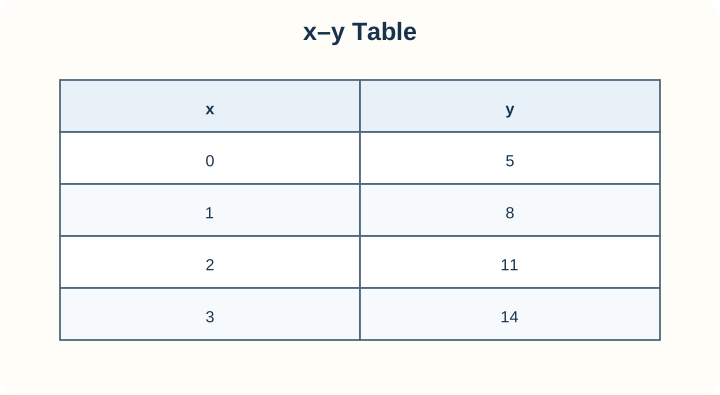
x–y Table: x and y with 4 rows. Open full size
Your answer
Show answer choicesHide answer choices Work through the mathematics first, then compare your reasoning.Select the answer that matches your work.
Answer choices
With a free account

Try the session again.

Return to a past session and redo it when you want another look at the same skills.

Create a free account
With paid access

Make a more precise practice set.

Choose from the complete range of objectives and problem types in your subscribed course when building a session.

Compare plans

Hint

Look at two consecutive rows, such as when x goes from 0 to 1, and subtract the y-values to find how much y changed.

Rate of change tells how much y changes each time x increases by 1.

Solution walkthrough

01

Read the consecutive table pairs

\[(x,y)=(0,5),(1,8),(2,11),(3,14)\]

The inspected table advances x by one in every row and supplies the matching y-values.

02

Calculate each input change

\[1-0=1;~2-1=1;~3-2=1\]

Every row-to-row move increases x by one unit.

03

Calculate each output change

\[8-5=3;~11-8=3;~14-11=3\]

Every corresponding move increases y by three units.

04

Check the rate

\[\Delta~y/\Delta~x=3/1=3\]

The constant ratio of output change to input change is three.

05

State the rate in words

\[y~\text{increases}~by~3~\text{for}~\text{each}~1-\text{unit}~\text{increase}~\text{in}~x.\]

This sentence gives both the direction and amount of change for the required input step.

+

Another way

  1. Compare the first and last rows: y changes by 9 while x changes by 3, so the per-unit rate is 9/3=3.

!

Common mistake

Do not report only that y increases; the prompt asks for the amount of y-change per one-unit x-change.

Solution walkthrough video