All courses Math Foundations · MF.GR.6 45 of 60
Interpret intercepts and starting values in contextual linear situations.

Find the starting value

Problem
A table contains \((0,~18)\), \((2,~24)\), and \((4,~30)\). Determine the starting \(y\)-value from the point with \(x~=~0\).
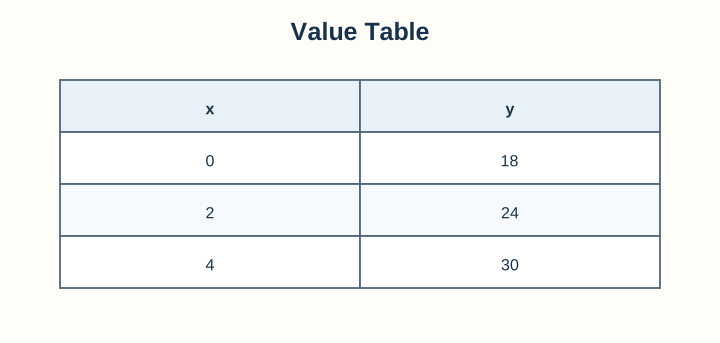
Value Table: x and y with 3 rows. Open full size
Your answer
Show answer choicesHide answer choices Work through the mathematics first, then compare your reasoning.Select the answer that matches your work.
Answer choices
With a free account

Turn a few problems into a learning session.

Choose a course and objective, collect included problems into a session, and work through them in order.

Create a free account
With paid access

Build sessions from the full problem bank.

Choose the objective you need and make a learning session using all of its available problem types and variants.

Compare plans

Hint

Find the row in the table where x = 0.

The starting value is the y-value paired with x = 0.

Solution walkthrough

01

Use the definition of starting value

\[\text{starting}~y-\text{value}~=~y~\text{when}~x=0\]

The starting value of an x-y relationship is read at the zero input.

02

Locate the zero-input row

\[x=0~\to~y=18\]

The inspected table includes the pair (0,18).

03

Check against the remaining pattern

\[(24-18)/(2-0)=3;~18+3(4)=30\]

A rate of three per x-unit carries the starting value eighteen through the other rows, confirming the read.

04

Report the starting value

\[18\]

At x equals zero, y equals eighteen.

+

Another way

  1. In y=mx+b, the zero-input output is b, so the pair (0,18) gives b=18 directly.

!

Common mistake

Do not choose the first positive x-value's output; the starting value is specifically tied to x=0.

Solution walkthrough video